
absolutely intercultural 140 +++ multiculturalism +++ social media +++ The Consultants-E +++

The Consultants-EIn this show we’ll be going to Ireland and asking if multi-culturalsim is dead then what should replace it? We’ll also be hearing from another Irish man, Robert O’Dowd, based in Léon, Spain about the added value of multimedia when doing online intercultural exchanges and from two of the current participants in the Podcasting course offered by The Consultants-E. I’ve been tutoring various online courses there and it has often struck me how intercultural these EFL teachers are and so this time I took the opportunity to find out more about them. For example I discovered one of the issues facing female Saudi students who want to study abroad.

absolutely failed
But we’ll begin with Stephen Spillane in Ireland, a political blogger whose latest post made me want to find out more. Stephen was picking up on the backlash against multiculturalism which is spreading across Europe and made an interesting suggestion about what to replace it with. So let’s hear Stephen explain why multiculturalism has absolutely failed. Soon after I had spoken with Stephen my eye was caught by a recent report with the headline Employers looking for global awareness in young recruits, which is a kind ofpositive reply to the negative comment Stephen got to his post, and tells us that intercultural awareness is a sought after quality by employers. You can find the link to that report here.

absolutely global
In my work with The Consultants-E helping English teachers integrate technology into their everyday practice I have met (virtually of course) many interesting people. Usually the teachers fall into two categories; either they teach gloriously mixed classes in their home country or they are the ones who have moved to teach in a new culture. So in our next category, absolutely global, we are going to meet two teachers from my current podcasting class as I thought it only right for them to experience podcasting from a different perspective. First I talked with Janice Ford, an Australian based in Sydney who has taught English to students from all over the world. Janice talked to me about some of the nice moments with her international groups. I then spoke with Samah Thabet, an Egyptian woman who has been teaching in Saudi Arabia or KSA, for the last four years. I was curious about Samah’s students also. In fact my chats with Janice and Samah and others from my course were much longer so watch out for more from them in later shows. If you would like to practice your English you can try the dictation based on a short extract from this category at Listen & Write.

absolutely social
In our final category I am bringing you an extract from a free webinar offered by the Language Learning and Social Media project on the topic of social media and interculturality. Entitled Give interculturality a chance – Can social media make a difference?” I was one of the invited speakers and you can access my recorded slideshow at SlideBoom.  The webinar featured Fred Dervin from Finland and Christine Develotte from France who presented some very interesting statistics about the use of social media and Liang Wang from the Open University in Milton Keynes in the UK who talked about the social media habits of Chinese students. The webinar also included a presentation by Robert O’Dowd based in Léon, Spain who talked about the multimedia exchange between his Spanish students and a group in the USA. Does multimedia help to raise intercultural awareness in an online exchange? So if Robert O’Dowd’s comments have whetted your apetite then you can find the link to the whole webinar here.

Thanks very much to everyone who took part in today’s show. We couldn’t do it without you! If you have any comments, criticisms or suggestions then please add a comment here on the blog.

Our next show will be coming to you from Dr. Laurent Borgmann in Germany on 5th August 2011

The host of this show is: Anne Fox
Editor: Markus Scherer

absolutely intercultural 136 +++ storytelling +++ grammar of culture +++ Herrasti +++ Oluwatoyin Kole +++ Nigeria +++

Grammatica del la CulturaThis show we will be mainly about storytelling as we meet the author of a book about intercultural communication and explore the art of story telling in Africa and as you will hear this does not just mean talking. We’ll be talking to the author of a new book on the grammar of culture and finding out the role of stories there and finding out some of the key features of story telling in the African tradition.

absolutely necessary
Natalia Pérez de Herrasti told us about the first volume of her new book called Grammatica del la Cultura, the grammar of culture. As you can guess the book is in Spanish. So why do we need to be aware of the grammar of culture? We discover that this is a way of making sense of the stories or critical incidents that are the starting point for so much intercultural training.

absolutely participatory
And now for the first time on Absolutely Intercultural you will be given a taste of African story telling. This is not just a case of ‘Are you sitting comfortably? Then I’ll begin’. This is absolutely participatory. Oluwatoyin Kole from Nigeria was invited to demonstrate African story telling technique to a University of Florida class on Social change through communication. So first came a bit of pre-session training. Then we’ll hear an extract from the story which concerns a couple who have long been married but have not been able to have children. The husband consults the local diviner who says… If you want to experience the full story then you will have to follow this link. We also hear the start of the discussion after the story had ended.

So you heard the man! Let’s hear your stories. If you have any stories of critical incidents which happened to you or which you heard about and which made a difference to the way you think about things then let’s hear them. You can add them as a comment to this blog or you can send us an audio recording which we can include in our next show or we can arrange to meet you online so that we get a more interactive version.

Our next show will be coming to you from Dr. Laurent Borgmann in Germany on 10th June 2011

The host of this show is: Anne Fox
Editor: Markus Scherer

absolutely intercultural 131 +++ changing perspectives +++ annoying behaviour in class +++ hospitality club +++ freezing in Australia +++

Why do different people have different perspectives? How can the same person have different perspectives on traffic only because one time the person experiences it in the car and the next day on a bicycle? How do our perspectives on events change over time. How big is the cultural influence on our perspective? And how does our perspecive change when we move to another culture?

absolutely changed
All of us have different perspectives on the everyday things that surround us, we watch news on television, hear stories and we think we are perfectly informed about everything. But are we really? Sometimes a trip to another country or a new episode in our lives can change our perspective on the World dramatically.
Take Paul MacAlindin for example. He moved from small-town Scotland to big-town Germany and this move changed his geographical perspective to one which for Continental Europeans seems very normal.

absolutely irritating
Emese Bognar an exchange student from Hungary, vividly illustrates different perspectives and changing perspectives when she told me what irritated her when she attended a lecture and how her perspective on traffic changed, when she did her driving license.

absolutely hospitable
Agnes Dus from Hungary interviewed Adelheid Korpp, who had tried the “hospitality club”, which is a clever system for travelers to get cheap accommodation. The traveler applies for accommodation to a host, contacts the host and asks if they can stay for 1 or 2 nights. This seems to be a pleasant way for travelers to get around and have a cheap bed for the night. However, more importantly, this could be a good way to change your perspective from that of a regular tourist to that of a dear friend invited to the country. But let us listen to Adelheid how this works in detail, because first of all you need to get approved.

absolutely freezing
In our fourth and last category Roman told me about his time in Australia; he spent a semester at the University of the Sunshine Coast in Queensland and we now really have to change our perspectives here, because he is telling us that in the middle of the Australian summer you can still feel pretty cold, but listen to him yourself.

Our next show will be coming to you from Anne Fox in Denmark on 01 April

Until then –
Bleiben Sie absolut interkulturell!

The host of this show is: Dr. Laurent Borgmann
Editor: Dino Nogarole

absolutely intercultural 129 +++ comfort zones +++ dangerous situations +++ scary moments +++ classical artist +++

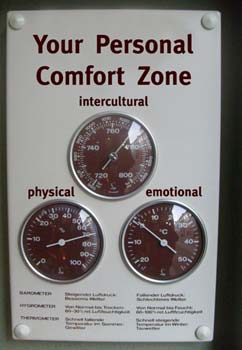
your comfort zoneWelcome to show 129 of our Podcast “absolutely-intercultural”. Thanks you again to all of you who have helped us win in the non-profit category of the European Podcast Awards (fourth place in Germany and even number 1 in Denmark!). We really appreciate all your input and the attention our podcast has received as a result. We feel absolutely comfortable seeing that what we produce seems to have a wide audience of listeners.

absolutely scared
Today we are going to talk about comfort zones and especially leaving our comfort zones. A comfort zone is the place where you feel comfortable, where everything seems to be easy and under your control. But what happens if you have to leave this comfort zone because of a change in your life or if you decide out of your own free will to leave your comfort zone? In our first category I had a meeting with people who have chosen to spend some time outside their comfort zones – by going to a foreign country: Lucy from Australia, Gintare and Vaida from Lithuania and Yasha from Turkmenistan decided to leave their comfort behind and experience something new. They left their home countries and entered a new world. I asked them which situations in their new lives were the scariest.

absolutely dangerous
If the feeling is strong, you may even feel out of place or unsafe in your new environments. This happened to Beatrice, when she went to Egypt on a holiday for the first time and all the new impressions, smells, the loudness of the street and the different behaviors of people she met, made her feel like a fish out of the water and she was even a little scared. In our second category I asked whether she could still remember leaving her comfort zone for the first time.

absolutely prepared
In our next category I will return to our round table, where the foreign students tell me how they try to introduce familiar objects from their home countries into their unfamiliar surroundings in order to be a little more comfortable even outside their comfort zones. But first I asked the participants to tell me what situations in their host country made them most uncomfortable.

absolutely comfortable
When I was putting together this podcast it seemed that nowadays it is a universal truth that we need to leave our comfort zones all the time? But can that really be right? I went out of my way to find someone who says that there are professions where everybody would want you to stay within the comfort zone. How ironic, I actually had to find an artist who would speak in favor of comfort zones so in our fourth and last category I finally spoke to Paul MacAlindin, a classical musician who is active in organizing international orchestra performances, e.g. for the National Youth Orchestra of Iraq, of which he is the Musical Director. I asked him where he leaves his comfort zones during his artistic work and also in his private life. To my surprise he explained that in classical music most stakeholders prefer not to leave their comfort zones.

Our next show will be coming to you from Anne Fox in Denmark on 05  March

Until then –
Bleiben Sie absolut interkulturell!

The host of this show is: Dr. Laurent Borgmann
Editor: Dino Nogarole

absolutely intercultural 128 +++ Nigeria +++ Rosinski +++ coaching +++ Roskilde +++

In this show we’re going to be taking you to Nigeria, the Netherlands, France and the US. One of the great things about the Internet is the niche marketing it allows. One example of this is the radio show Culture Shock: Nigerians in America on Splash FM in Nigeria and which is also podcast. It’s billed as a new talk radio show connecting Nigerians in Nigeria to Nigerians in America and hosted by Abimbola Ishola and Kunle Ayodeji. We’ll also be hearing from Philipe Rosinski, intercultural coach for international business presenting his thoughts about why the coaching approach works in intercultural situations and later talking about some of the cases he has dealt with. 

I’d also like to say hi to Nina Liakos in Maryland who interviewed me about a week ago about this podcast as part of her efforts to learn about how to podcast with the help of the Evonline sessions sponsored by TESOL every year in January. Nina, you did a fantastic job! It was a pleasure talking to you and very relaxing to be the interviewee for a change.

absolutely Nigerian
So let’s start the show by hearing from show number 21 of CultureShock Nigerians when they asked about the types of experiences and impressions newly arrived Nigerians to America had. You can hear more by going to cultureshocknigerians.com where you’ll find all the shows to date since it started last autumn. Thanks to Kole Odutola who alerted me to the show and to the producers for allowing us to bring you snippets. We’ll also hear from a Nigerian comedian Seyi Brown and his experience of coming to the US in 2008.

absolutely doctoral
Now if your interest in intercultural matters is academic you may be interested in a doctoral summer school open to any PhD student in the field which is going to take place in Denmark in early July at Roskilde University. It’s called Identity and Interculturality and will feature some of the greats in the field such as Michael Byram and Claire Kramsch. The 5 day summer school will concentrate on research methods and costs only 50 euros. The deadline to apply is February 28th. Thanks to Fred Dervin for alerting me to that and he is also one of the convenors of the summer school which will take the form of lectures, workshops and roundtables.

absolutely universal
Another way of learning which is becoming very popular these days is through coaching. Our next slot features Philipe Rosinski who gave an hour long webinar on his experiences as an intercultural coach. The webinar was organised by SIETAR which is the Society for Intercultural Education, Training and Research and you can enjoy the whole webinar on their website for free. In the first extract, we’ll hear how Rosinski needed to adapt the coaching approach so that it was a little less American.

absolutely mixed
Rosinski has written books about intercultural coaching, the latest one is called Global Coaching, while the earlier Coaching across Cultures describes the tool he has developed to help individual and teams find out their strengths and weaknesses in the intercultural area. You can try out the individual tool for free by clicking here. What it does is highlight your preferences in terms of a whole range of orientations such as hierarchy, multi-tasking, formality and communication styles and compares them to your abilities in those areas. In a team situation it would help for example to discover if half your team preferred to multi-task while the other half are expecting tasks to come one at a time. The orientations are those which tend to differ in different cultures and build on the ideas of the pioneers in intercultural communication such as Hofstede and Edward T Hall. I tried the test and discovered that I might have difficulty working in a very hiearchical setting for example. Let’s hear now how Rosinski could apply the results of the test to a team of Dutch and French employees involved in a merger.

Our next show will be coming to you from Dr. Laurent Borgmann in Germany on 18th February

So long … stay tuned!

The host of this show is Anne Fox : Editor: Dino Nogarole

absolutely intercultural 127 +++ e-mail addicted +++ communication guide +++ social media +++ digital media +++

Today we are going to talk about how important social media and email have become in our lives. Do they help us be more productive or do they dominate our daily lives? 2010 may have ended peacefully and the holiday season was pretty calm but what was your first look at the internet like when you came back to work? Hundreds of email messages that were waiting for an answer? Dozens of requests to join somebody’s Linked-In network or to accept or decline messages because you are the moderator of a list or a blog? To be honest, after 10 minutes at the computer where I felt like a fire-fighter trying to get the worst catastrophies under control I was tempted to shut down the computer and do some “real work”. But did I? No, somehow I felt I needed to write quick answers, press “Like” butt0ns on Facebook and accept digital invitations because it all looked so urgent and real even though I was alone in my office and all the urgency was “only digital”.

absolutely addicted
I met Elaine and Will and had a discussion about how to monitor your work-life balance and perhaps separate your business and your private lives. In this respect almost all my friends fall into one of two very separate cultures and will explain to you that their particular work situation (rather than their own choice) determines their behavior. Are you the kind of a person who will switch off totally after work and recharge your batteries so that you can perform well in the work place afterwards? Or are you always connected and keep checking your email account at home even when you should be preparing dinner? If you decide not to look at your work email at home, does that this really mean that you are less than fully committed to your job or does the constant digital connection to your work place show that you cannot let go and eventually lead to burn-out syndrome? However we deal with this, most of us somehow have a bad conscience about our work-life balance one way or another, so let us discuss this and see whether digital addiction is actually a bad thing? In our first category Elaine and Will describe how two partners deal with this daily challenge in very different ways.

absolutely professional
In our second category Andreas Faulstich tells our interviewer Maria that some badly written email messages can drive him crazy and cause him a lot of extra work. Fortunately, there are only few messages which steal his time. Listen to how he tries to deal with these messages and how he suggests writing email messages more professionally. First, Maria asked Andreas how many email messages he receives every day?

absolutely connected
In our last category we organized a round table where I am talking with Lucy, Emese and Markus about how students who leave their home universities and study abroad can stay connected with family, friends and their home university through the digital media. Do we perhaps need to choose different channels for different target groups?

Our next show will be coming to you from Anne Fox in Denmark on 04. February

Until then –
Bleiben Sie absolut interkulturell!

The host of this show is: Dr. Laurent Borgmann
Editor: Dino Nogarole

absolutely intercultural 126 +++ small talk +++ Frendo +++ Korea +++ respect +++ apps +++

Happy New Year or should that be Appy New Year from Absolutely Intercultural, the podcast about all things intercultural? My name’s Anne Fox and this podcast is coming to you from Denmark. This is show number 126, the first one of 2011 or 20 11 as I should probably start to call it. So why Appy New Year? Well in this show I will be introducing you to 3 so-called apps which could help you in your efforts to understand more about intercultural communication.

This is the first time I’m making a show after learning about our win in the European podcast awards for 2010. We won in the non-profit category and I just want to add my thanks to all those of you who voted for us and also to all those of you who have contributed to the show by speaking with me and Laurent over the years. Without you as our conversation partners this podcast would be impossible.

absolutely trivial
The topic of small talk is often part of a language course, though not a very important one. But when I talked to Evan Frendo in Germany I discovered that small talk is actually a very important building block of working relationships. Here are links to Evan’s blog and his latest book, Intercultural Business English for German learners of English working in Asia.

absolutely useful?
You may remember that in my last show we found out about South Korea from a Chinese perspective when I spoke with Carol who is doing a year’s study exchange there. What also interested me was how she was going to use Korean when she went back to China. So is Korean absolutely useful to Chinese people? Thanks again to Carol who got in touch with us to tell us about her Korean experiences. She certainly showed herself to be adaptable when faced with a sensitive intercultural situation.

absolutely adaptable
And adaptability is something which Kenyan teacher, Samuel Osamba still needs to practice even though he has been in the USA for over 20 years now. Let’s hear how absolutely adaptable he needs to be in the classroom.

absolutely word for word
I think that culture and language are closely connected which is why we often also talk about language learning on this podcast. As a teacher I am very impressed with the web site called Listen and Write in which language learners can do dictation exercises around short audio snippets often from YouTube videos or Voice of America broadcasts. Since we sometimes get asked for transcripts of the show I wondered if we could combine the two and upload short extracts from the show to Listen & Write for you to work with if you are a language learner. So the first one features the first part of Evan Frendo’s segment about small talk.

absolutely essential
But am I right in thinking that culture and language are inextricably mixed? I have recently read a blog post by a respected English teacher who said that he didn’t see any reason to include intercultural communication in his English classes. Since Evan Frendo includes a great deal of intercultural communication in his classes I asked him for his view. Is it absolutely essential in language teaching?

appsolutely mobile
After speaking with Evan I signed up to his Twitter feed and discovered a link he had posted about a language app. Apps are small programs that you can download to your mobile phone, tablet or mp3 player. There are thousands of them and I suddenly became curious whether there were any to do with intercultural communication. So in this final segment we’ll go appsolutely mobile (and I hope you heard my pronunciation there!)

So the first app is called Word Lens and works by translating any sign that you photograph. At the moment the only language pair available is English and Spanish so this means that you can photograph a Spanish sign and get an English translation or vice versa. Useful for restaurant menus I would imagine. The catch here though is that although the app is free, you have to buy the dictionary. But when it works, it’s like magic.

The second app I found was called Fasten Seatbelts and this gives you snippets of information about different cultures both in text format and in the form of short videos. Now this one is completely free. The first edition was a collection of Do’s and Don’ts for European countries and the second edition now covers a range of Asian countries.

The third app I found is called Cultural GPS and allows you to see the different Hofstede profiles for 98 different countries in the free version. In the pro version you can create your own personal cultural profile and compare it to any one of the 98 countries or compare pairs of countries to highlight differences and similarities. This is the one I liked the most and I’d be really interested to find out what you think about it.

All in all I think that this was an interesting little project but I have come to the conclusion that these apps can only help with simplistic culture specifics and don’t really help with the more rewarding culture-general aspects of intercultural communication. But maybe you know of other interesting apps? If so then do tell us about it in a comment here on the blog  or send us an email. We’d also be very happy if you recorded something for us to include in the show. Well that’s it for this show.

Our next show will be coming to you from Dr. Laurent Borgmann in Germany on 21st January.

So long … stay tuned!

The host of this show is Anne Fox : Editor: Dino Nogarole

absolutely intercultural 125 +++ Christmas time +++ New Year’s resolutions +++ international Xmas +++

Today is the 24th of December – this means Christmas trees, mulled wine, lots of snow recently, and if you were lucky you may have spotted the odd reindeer. In our show today I asked how my guests celebrate Christmas in Australia, Hungary and Germany but also how people formulate their New Year’s resolutions in different cultures.

absolutely santa
Our exchange student and podcast enthusiast Lucy Warren talks to Barbara Neukirchen, who is responsible for the outgoing students from RheinAhrCampus, Remagen. Lucy is interested in how Barbara celebrates Christmas time and whether this could be seen as typical for Germany. In our first category Barbara tells Lucy on which days Germans celebrate Christmas and how they celebrate the count-down to Christmas.

absolutely positive
Have you thought about your New Year’s resolutions? For example stop smoking or drinking less alcohol? Or losing a couple of pounds by going to the gym regularly? I asked Beatrice about her resolutions and she explained to me the difference between positive and negative ones. In our second category we listen to Beatrice’s view about New Year’s resolutions.

absolutely festive
I put together a round table with Lucy from Australia, Emese from Hungary and Andreas from Germany. All of them shared their typical customs and Christmas traditions from their families with me. Of course this does not mean that everybody in their culture celebrates in the same way – sometimes this may be just the culture of that particular family or region. Let us listen to very different experience which range from Christmas on the beach to Advent Calendars.

Our next show will be coming to you from Anne Fox in Denmark on 07. January 2011

The Team of “absolutely-intercultural” wishes you a Merry Christmas and a Happy New Year! Thank you for supporting us!

Until then –
Bleiben Sie absolut interkulturell!

The host of this show is: Dr. Laurent Borgmann
Editor: Dino Nogarole

absolutely intercultural 124 +++ Soundcities +++ Korea +++ Kenya +++ TED talks +++

absolutely urban
Recently I came across an intriguing project called Soundcities. The project started in the 90s when an anonymous British artist known as Stanza started making sound recordings in cities all over the world. You can now go to the Soundcities website and choose a city or a mood and hear the sounds associated with it. Of course I went straight to the collection for Aarhus which is my nearest big city and among other things, found the familiar sound that the pedestrian crossing plays when it’s safe to cross the road. The project isn’t over yet so if you fancy going out and making some recordings then Stanza would love you to upload them to the website to add to the database. So what sounds would you record for your city? Well before you decide I’d like you to sit back and relax for three minutes while I play you a medley of sounds from a well-known city. The question is, can you guess which one?  So where did those sounds come from? I’ll be kind and accept answers from the right country. I recommend you go to soundcities.com and play around with the map and the sounds that you can find there. I also recommend the Soundmaps mixer page where you can create your own cacophony using the mixer on the page.  So where did the soundscape come from earlier in the show? I wonder if you guessed Asia? I wonder if you guessed South korea? The sounds in fact came from Seoul. I thought that would be the most appropriate to play for our conversation with Carol.

absolutely delicious
I was delighted when Carol from China contacted us saying she’s be willing to talk to us about her experience as an exchange student in Korea. Carol studies Korean and English at Nanjing Normal University in Jiangsu Province in China. She arrived in Korea in August and we talked about various things including food so this is the absolutely delicious segment but first I couldn’t resist asking how she had heard about our podcast.

absolutely on time
Samuel Osamba has been living in the US for 20 years but is originally from Kenya to which he returns on project work several times a year. He tried to leave a comment on the blog after our piece on the intercultural business webinar in October but there was a technical glitch. That is now solved so thank you Samuel for letting us know about that but also I was curious to find out more so I arranged to ring Samuel to see if he had another perspective on the issue of timekeeping in our segment absolutely on time. Samuel you’re quite right that Africa does not feature often enough in our podcast so if there is anybody out there from Africa who has some interesting stories to tell then please do get in touch.

absolutely critical
I’m not sure that we’ve had recorded critical incidents on this show before but I managed it as I spoke to Carol from China about her year abroad in Korea. Listen as I get it completely wrong not just once but twice in the space of five minutes in absolutely critical!

absolutely back to front
For our last segment I decided to play you one of the shorter sessions from TED talk. If you don’t know TED Talks yet then I strongly recommend that you go over to TED.com and choose one or two from the amazing selection of recorded talks by some amazing people. The TED talks are even starting to have their own superstars such as Sir Kenneth Robinson and Professor Sugata Mitra who both talk about education or Hans Roslin who makes statistics come alive or Jill Bolte Taylor giving a minute by minute account of a massive stroke she had. The TED slogan is ‘Ideas worth Spreading’ and I think they are addictive so watch out. The one I’m going to share with you today is by Derek Sivers’ entitled ‘Weird or just different?’ which is about how what you think may be true may not be true or absolutely back to front! One of our very first podcasts featured South African, Mark Anderson who went to South Korea and specifically mentioned this problem that the streets have no names. So now four years later, problem solved!

Our next show will be coming to you from Dr. Laurent Borgmann in Germany on 24th December

So long … stay tuned!

The host of this show is Anne Fox : Editor: Dino Nogarole

absolutely intercultural 123 +++ stereotypes +++ traveling +++ foreign countries +++

On this show (no. 123) we will hear from the US, from South Korea and from Lebanon in the Middle East. I think this mix promises your dose of culture shocks from around the world and insights into new ways of thinking.

absolutely unpunctual
Have you ever made the experience that you traveled in a foreign country and because of your preparation or knowledge about this country your head is spinning with ready-made clichés about the people in that country? Often, when we are well prepared we really have the impression that we know a lot about the country we visit and the people who live there – but are these preconceived ideas the truth? Are they even helpful? In our first category I talked with Yoav Wachsmann, an American professor (originally from Israel) who travels a lot and comes over to Germany regularly. He told me what he liked most about his time in Europe but also how he had to revise his stereotypes as he was getting to know the Germans. He tells us an interesting story of misinterpretation where he thought that his German students were always late for their class until he discovered that in German Academia there is a system which could be called “formalized impunctuality”.

absolutely perfect
In our next category Anne Gründer, a student from Rhein Ahr Campus in Remagen told me why she took South-Korea as her destination for her semester abroad and what her friends’ reaction were like when they hear about that. Let us listen to how she enjoyed her trip to a completely different world and culture and how she spent her time in Korea.

absolutely specialized
Jennifer, an American professor who is teaching in Lebanon told me her story! She comes from Boston, in the US, is married with a Lebanese and is now living in Beirut. Many people back home are worried about her safety, because it seems to be dangerous living there, particularly as an American. But is it true? Is life more dangerous than in the US? In our last category Jennifer shared with me some stories, experiences she made in class and what she is missing most from the American culture.

Our next show will be coming to you from Anne Fox in Denmark on 10. December

Until then –
Bleiben Sie absolut interkulturell!

The host of this show is: Dr. Laurent Borgmann
Editor: Dino Nogarole