
absolutely intercultural 149 +++ Queen and Obama in Australia +++ Day in the life of Laurence +++ Master in International Marketing +++ EXlites solar lighting +++ stereotypes French-German +++

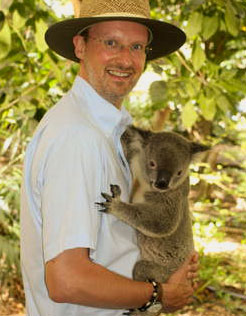
kangaroo road sign near to the University of the Sunshine Coast (photo L.Borgmann)Hello Mates and G’day, this is show 149 of our podcast absolutely intercultural. And it is coming to you all the way from down-under, Queensland, Australia where I am teaching and doing some research for one semester. Two months ago, in October 2011, the Queen of England visited Australia. Only a month later, in November by the President of the United States came to Australia, too. And now, in December I started my summer term as a visiting academic at the University of the Sunshine coast (LOL). So who am I? My name is Elmar-Laurent Borgmann and after all these important state visits which were widely reported about in the Australian media I would today prefer to concentrate on more mundane,  everyday aspects of life in Australia as experienced by a European. And yet, I hope we will be able to surprise you with some stimulating intercultural findings. Our interviewees today are from France, from Germany, and of course from Australia.

absolutely down-under
Let us look at an ordinary day in Australia. Some people back in Europe listened to my absolutely down-under reports during my last stay in Australia. They had heard about a “Tropical Christmas by the Pool”  or a “National Australia Day” which I described both in previous shows and learned a lot about intercultural differences.  However, some of them asked me to concentrate more on a the normal, regular, everyday life in Queensland. And they are right – we do expect holidays and celebrations to be different in different countries – but how about a regular university day? Hmm, what a challenge. I had thought this was too boring to record but maybe not? So, I followed myself with the microphone and recorded my intercultural impressions one morning from getting up at 7 o’ clock until I arrived at the University of the Sunshine Coast at 9. You will notice from my comments how much I like this part of the world – except for the first minutes after waking up – I admit, I am not a morning person. In the podcast you catch me waking up with my windows wide open to the tropical forest. In a second part later in the show I continue my intercultural report about a regular Australian morning going to work on the Sunshine Coast in my car. I would like to share some thoughts about beautiful landscapes but also of rather masculine-looking cars and trucks in this country before I arrive at the University of the Sunshine Coast where finally I see some wild kangaroos, not on a road sign but in real life and much closer than I expected …

absolutely business-like
I will also take you into the university, where international students from Europe will describe how in their International Marketing Class they did some work for an Australian Business. The round-table discussion was recorde after an exam situation a couple of weeks ago right at the start of the summer semester 2011/2012. To me summer 2011/2012 still sounds rather weird as in Europe only winter semesters could span two calendar years. So this is just another reminder that we are in the southern hemisphere. But back to the classroom. I was invited to sit in on the exams of students on the Master of International Business program. Apart from myself as external examiner, there was of course Dr. Leone Cameron, the regular lecturer but also, Mike Arieni, Managing Director of EXlites, a regional business for whom the group of international students had done some research about solar Energy in Europe. I asked the group how this combination of international students, an interculturally trained lecturer and a local business person enhanced their academic progress. Leone’s Master course the students had the chance to get in touch with a real business man and help him prepare his business plan for entering the European Market. Just like Mike, I, too, was impressed by the depth of the students’ research and I had a feeling that Mike took very good notice of the opportunities and challenges that the students presented for the different European countries. In a second part we will also hear from Waldemar Schneider and Clément Slastan about some of the stereotypes the international students confirmed when they lived together in shared apartments. Clément seems to have noticed a certain “lack of flexibility” in the Germans.

Once you have heard the show, please go to our “write us an email“-button in the right margin and tell us whether you liked these slightly unusual intimate insights into my own life down-under and whether you would like to get more such personal reports.

Our next show will be coming to you from Anne Fox in Denmark on 6 January.

Until then –
Bleiben Sie absolut interkulturell!

The host of this show is: Dr. Laurent Borgmann

absolutely intercultural 148 +++ Languages +++ Acadie +++ French +++ Yoruba +++ Michot +++ Benin +++ Baloubi +++


USA Photo Text Graphics
Myspace Layouts

In this show we’ll be looking mostly at languages in the US and how that helps or hinders intercultural understanding.

absolutely Francophone
We’ll start with Louis Michot, one of the prime movers behind the Cajun Punk band the Lost Bayou Ramblers. In show 144 we heard about their music and what it meant to the band members as well as its cultural roots. Another topic that we talked a great deal about was the status of the French language in Louisiana. I made a trip to Louisiana many years ago and I have to say that the language was not really evident but when I talked to Louis I discovered that this was because it was mostly hidden. So the question is why would anyone in Louisiana want to hide the fact that they can speak French? And do people in Louisiana still learn French? Is it absolutely francophone?

absolutely informed
So there’s a lot of sensitive history behind the survival of the French language in that part of the United States. Then a few weeks ago, my eyes and ears in Florida, Kole Odutola alerted me to a Communiqué sent out by the Southeast African Languages and Literatures Forum on October 2nd, which read:
We, the members of Southeast African Languages and Literatures Forum (SEALLF) at the second annual conference of the forum held at the Chapel Hill Campus of the University of North Carolina, acknowledge that in view of the internationalization of the curriculum at many American colleges and universities, there is the need to increase the number of American undergraduate and graduate students engaged in the study of critical languages of Africa.

In the wake of the 9/11 attacks many US universities beefed up their foreign language requirements in recognition of the fact that to understand another culture it helps greatly if you know a bit of the language. So here was a Communiqué suggesting that the foreign language requirement should more often lead to the learning of an African language such as Yoruba. But why? To find out more I spoke to Dr Désiré Baloubi of Shaw University in North Carolina, the Chair of the Forum behind the Communiqué. And during the course of our conversation I also learned a new acronym, HBCU, which stands for Historically Black Colleges and Universities. So why does an English teacher start a campaign to promote the learning of African languages?

absolutely illegal
The issue of language just doesn’t go away and after finding out how and why Louis Michot learned French, I spoke to his father Tommy Michot to find out more about attitudes to the French language in the recent past and discovered that at one point it was absolutely illegal! We’ll start by hearing as Tommy Michot sings in French a snippet of  La Valse de la Meche Perdue with his band Les Frères Michot.

Thanks to all those who took part and remember that if you’ve got a good idea for a show then get in touch and we’ll see if we can include it. We’re always on the look out for interesting people and ideas. Don’t forget to take a look at our webiste if you want to follow up on some of the people or issues we’ve looked at in this show. You’re welcome to leave us a comment about what you thought, a question or a suggestion.

Thanks for your support which got us all the way to a European Podcast Award last year. The nominations are open for this year’s competition and as part of the PR around the award I was interviewed about this podcast and what it meant to win the award. You’ll find a link to that podcast here.

Well it’s been a busy few weeks in which amongst other things I took part in the Managing Cultural Diversity seminar held every year at the Rhein Ahr campus. And this year there are pictures so here is a link to the Facebook Album. And as if this wasn’t enough, my co-host Laurent Borgmann is once again leaving for Australia for a few months. So in order to make things more manageable we have decided to go monthly. So watch out for the next show which will be coming to you from Down Under!

Our next show will be coming to you from Dr. Laurent Borgmann in Australia

The host of this show is: Anne Fox


absolutely intercultural 146 +++ Matthew Hill +++ intercultural trainer +++ SIETAR +++ Aarhus University +++ Chinese +++

In this show we’ll be finding out about the work of intercultural trainers. Did you know there was an organisation for intercultural trainers? It’s the Society for Intercultural Education, Training and Research and if you go to their website at SIETAReu.org you’ll find lots of useful information and links for intercultural trainers there. We’ll be hearing from Matthew Hill about the importance of the biennial SIETAR conference which took place in Cracow,  Poland at the end of September.

absolutely trained
So let’s start the show by hearing from Matthew Hill, based in the UK, who is an intercultural trainer. I was interested to find out what that involved.

absolutely Chinese
What sort of experiences do expatriates have? Laura Dombernowsky, of Aarhus University interviewed some of the current Chinese students studying there to find out how they were finding Denmark.  My thanks to Laura for allowing us to feature part of her interviews. You can see the whole film on YouTube with subtitles.  Laura is currently in Bejing as part of her journalism PhD so I hope to catch her when she returns in January and hear about her experiences.

absolutely informed
While I was talking with Matthew Hill, of Hill Networks, I had the impression that the business is dominated by independent freelancers so how do they find out what’s new in their field? Well one way is to attend conferences such as the Congress recently held by Sietar in Poland. What benefits are there from attending?  Matthew Hill explains what happens at the conference.

absolutely connected
Matthew Hill was not just a delegate but also a presenter at the conference. His session centred on what intercultural skills you need when presenting a webinar to an intercultural audience. Of course one of the key factors is the language that you use. Matthew’s whole talk is on YouTube but you can hear a snippet on this show about the importance of language in webinars.  One of Matthew Hill’s latest projects is a CD about managing intercultural conflict. The CD will take you through a process lasting about an hour after which you’ll end up with a plan for managing conflict. So if you’re interested in finding out more about that you should email Matthew Hill at this address, matthew.hill@hillnetworks.com .

Our next show will be coming to you from Dr. Laurent Borgmann in Germany on 28thOctober 2011

The host of this show is: Anne Fox
Editor: Markus Scherer
Photo credit: Michael Nyika on Flickr


absolutely intercultural 144 +++ Cajun +++ Louisiana +++ Michot +++ Lost Bayou Ramblers +++ Les Freres Michot +++

This show is rather special in many ways and may be a little longer than normal. As you may have guessed from the musical intro we’ll be going to Louisiana to find out the link between culture, work and music; and the people we’ll be meeting are father and son, Tommy and Louis Michot. I first met Tommy through my husband about 20 years ago. They are both biologists and when we went to Louisiana to visit Tommy’s family, I discovered that Tommy is also a serious musician; serious in the sense that he and his brothers, Les Freres Michot, tour, and make albums. We also met up at several academic events in Europe where there would always be occasion for Tommy to get out his squeezebox and share the Cajun music of Louisiana which is sort of what you heard at the beginning of the show.

And then as often happens, we lost contact. Suddenly in mid-August, my husband got an email from Tommy saying that his sons, Louis and Andre, now have a band called the Lost Bayou Ramblers and that they were playing at a festival in southern Denmark. So down we went to Tønder, near the German border, to hear and meet up with Louis and Andre in the Lost Bayou Ramblers. While the rest of Denmark seemed to be having a sunny day, a terrific thunderstorm was competing with the musicians for our attention, and festival goers were walking around the site ankle deep in water, making the whole thing look a little like a Louisiana Bayou. Meeting Louis and Andre after their set I realised that the music, the environment and their father’s career were all tightly interwoven and thought it might be interesting to unravel some of the pieces.

To set the scene you just need to know that the Cajuns of Louisiana were originally displaced people from France who came to Louisiana by way of Canada.

absolutely Cajun
We’ll start with Louis Michot who started out playing in his father’s band and has since gone on to form his own band with his brother Andre. The Lost Bayou Ramblers’ musc is rooted in Cajun but with a contemporary twist. Here’s Louis explaining what Cajun music is and how his band have updated it. That’s followed by a preview of the new single, Bastille, by The Lost Bayou Ramblers out at the end of September and then we hear from Louis’ father Tommy about where the word Cajun comes from.

absolutely interdisciplinary
Then I talked to Tommy about his work at the University of Louisiana and was amazed at how absolutely interdisciplinary his work is.

absolutely interconnected
Although Cajun music is rooted in tradition, I learned that Les Freres Michot also write new songs and that in one specific case the song arose out of one of Tommy Michot’s academic tasks. Let’s hear more about how work and play can be absolutely connected and then hear a snippet of the end result, La Valse de la Meche Perdue. You can try a short dictation from this segment at Listen and Write.

absolutely global
Finally we’re going to go absolutely global and hear once again from Louis Michot, this time about the B side of the Lost Bayou Ramblers’ new single Bastille which is also called Bastille and is a remix in a very different style. So we’ve gone from father to son, from work to play and from traditional to present day. One transition I haven’t had time for is French to English but we’ll take that in a later show so, finally, we’re going to go from local to absolutely global!

Our next show will be coming to you from Dr. Laurent Borgmann in Germany on 30th September 2011

The host of this show is: Anne Fox
Editor: Markus Scherer
Photo credit: Cajunzydecophotos on Flickr

absolutely intercultural 142 +++ George Simons +++ The Consultants-E +++ Bollywood +++ Internations +++

absolutely angry
In this show we re-vsisit the chat I had with George Simons in show 138. George you may remember is the creator of the Diversophy intercultural games. We also talked about other intercultural games and when I mentioned Barnga, which we described way back in show 43, he told me about another very effective intercultural game. You could tell this was a good one because it made people absolutely angry!

absolutely distant
It’s not just anger which is a symptom of your being out of your comfort zone. I was surprised when Janice Ford, an Australian talked about this feeling of being absolutely distant. Janice Ford took a course with me at The Consultants-E where I help teachers intgerate ICT into their language teaching and is just one of the many interesting people I meet there from all over the world.

absolutely incredible
You’ve probably heard about Bollywood, the Indian film industry, and how it rivals Hollywood in scope and numbers of films produced so now we’re going to hear from Rebecca Chadwick, who’s just finished high school and is so mad about Indian film that she signed up to a years course at the Asian Academy of Film and TV in New Delhi and simply flew straight into her course at the beginning of July having never travelled further than Europe before. If you watch satellite TV you’ll probably understand why I’m calling this strand absolutely incredible when I contacted Rebecca shortly after her arrival to hear about her first impressions.

absolutely social
Now perhaps Rebecca might have benefited from being a member of Internations, a website designed to help expatriates all over the world cope with being stationed far away from home. My final guest on the show today is Malte Zeeck, co founder of Internations and my first question was about why such a website is needed. If you like the sound of internations and would like to join, then get in touch with me through this blog as I have some invitations available. Perhaps you were inspired by our last show to organise a foreign internship or semester exchange? You can also test your English by trying a short dictation taken from this interview here.

Our next show will be coming to you from Dr. Laurent Borgmann in Germany on 2nd September 2011

The host of this show is: Anne Fox
Editor: Markus Scherer

absolutely intercultural 140 +++ multiculturalism +++ social media +++ The Consultants-E +++

The Consultants-EIn this show we’ll be going to Ireland and asking if multi-culturalsim is dead then what should replace it? We’ll also be hearing from another Irish man, Robert O’Dowd, based in Léon, Spain about the added value of multimedia when doing online intercultural exchanges and from two of the current participants in the Podcasting course offered by The Consultants-E. I’ve been tutoring various online courses there and it has often struck me how intercultural these EFL teachers are and so this time I took the opportunity to find out more about them. For example I discovered one of the issues facing female Saudi students who want to study abroad.

absolutely failed
But we’ll begin with Stephen Spillane in Ireland, a political blogger whose latest post made me want to find out more. Stephen was picking up on the backlash against multiculturalism which is spreading across Europe and made an interesting suggestion about what to replace it with. So let’s hear Stephen explain why multiculturalism has absolutely failed. Soon after I had spoken with Stephen my eye was caught by a recent report with the headline Employers looking for global awareness in young recruits, which is a kind ofpositive reply to the negative comment Stephen got to his post, and tells us that intercultural awareness is a sought after quality by employers. You can find the link to that report here.

absolutely global
In my work with The Consultants-E helping English teachers integrate technology into their everyday practice I have met (virtually of course) many interesting people. Usually the teachers fall into two categories; either they teach gloriously mixed classes in their home country or they are the ones who have moved to teach in a new culture. So in our next category, absolutely global, we are going to meet two teachers from my current podcasting class as I thought it only right for them to experience podcasting from a different perspective. First I talked with Janice Ford, an Australian based in Sydney who has taught English to students from all over the world. Janice talked to me about some of the nice moments with her international groups. I then spoke with Samah Thabet, an Egyptian woman who has been teaching in Saudi Arabia or KSA, for the last four years. I was curious about Samah’s students also. In fact my chats with Janice and Samah and others from my course were much longer so watch out for more from them in later shows. If you would like to practice your English you can try the dictation based on a short extract from this category at Listen & Write.

absolutely social
In our final category I am bringing you an extract from a free webinar offered by the Language Learning and Social Media project on the topic of social media and interculturality. Entitled Give interculturality a chance – Can social media make a difference?” I was one of the invited speakers and you can access my recorded slideshow at SlideBoom.  The webinar featured Fred Dervin from Finland and Christine Develotte from France who presented some very interesting statistics about the use of social media and Liang Wang from the Open University in Milton Keynes in the UK who talked about the social media habits of Chinese students. The webinar also included a presentation by Robert O’Dowd based in Léon, Spain who talked about the multimedia exchange between his Spanish students and a group in the USA. Does multimedia help to raise intercultural awareness in an online exchange? So if Robert O’Dowd’s comments have whetted your apetite then you can find the link to the whole webinar here.

Thanks very much to everyone who took part in today’s show. We couldn’t do it without you! If you have any comments, criticisms or suggestions then please add a comment here on the blog.

Our next show will be coming to you from Dr. Laurent Borgmann in Germany on 5th August 2011

The host of this show is: Anne Fox
Editor: Markus Scherer

absolutely intercultural 138 +++ Saudi Arabia +++ Iraq +++ NYOI +++ Diversophy +++ Refugee Week +++

Diversophy logoIn this show we’ll be hearing about how games can help your intercultural awareness. We’ll also be following up on a couple of items from the last show by going to Iraq to hear more about the National Youth Orchestra of Iraq initiative which brought Arab and Kurdish Iraqis together to make music and we’ll be re-visiting the issue of the right of Saudi women to drive cars in cities.
absolutely independent:
In the last show we went absolutely independent when we heard about the Saudi women who were going to drive their cars on June 17th in a bid to convince the authorities to accept this practice. Actually June 17th was not meant as a one-off but as a start date, but it seems that the day went well with quite a few women driving their cars with only minor brushes with the police as a result. This is in contrast to what happened with a similar action in 1990 when the women then were harassed by the authorities and other citizens and described as ‘The fallen: Advocates of vice and corruption on Earth’. ‘A source of depravity’ and when other citizens were advised to ‘Take whatever action you see fit’ to bring them under control. What’s the difference between then and now? Perhaps that, because of social media, the eyes of the world were on Saudi Arabia on this occasion.

absolutely social
So does social media such as Twitter and Facebook have an effect on culture? That is a question which I shall be exploring as part of a webinar organised by Christine Develotte and Fred Dervin on June 29th.  More specifically we will be looking at whether social media can actually contribute to developing intercultural competences. You will find the link to the free webinar here.

absolutely playful
We’ve covered games before and today we’re going to hear from George Simons working with Kati Volt about his Diversophy game, how it works and a bit of background about how the game is made. So how can you gain some intercultural awareness through a game? George Simons of Diversophy.com explains the game which started out as a face to face card game but now also comes in online and Android smart phone format. We also hear about sample cards in the game and how people react to them. In fact George and I had a great deal more to talk about; too much for one show, so you’ll be hearing more from George and his gaming approach in future shows. In the meantime you might like to try one of the Diversophy Android apps on your Smart phone.

absolutely musical
Now let’s be absolutely musical and hear a little more about that incredible orchestra put together by audition on YouTube which puts together traditional enemies, Arabs and Kurds, to play together in an Orchestra which is due to perform at the Beethoven Festival in Bonn this coming October. In previous shows we have heard from Paul MacAlindin, the conductor and Karin Wolf, the viola teacher, as well as the RheinAhr Campus students whose task it was to find a way of raising awareness of the event. In this show I will play you an extract from one of the videos put together to explain the background to this very special orchestra. You can see and hear the whole video here.

absolutely desperate
Did you know that this week is international refugee week? In Australia it was marked by an amazing reality show, Asylum Exit Australia: Go back to where you came from , in which over three consecutive nights you followed the journey of six ordinary Australians who made the refugee journey to Australia backwards; in the words of the programme makers :

Deprived of  their wallets, phones and passports, they board a leaky refugee boat, are rescued mid-ocean, experience immigration raids in  Malaysia, live in a Kenyan refugee camp and visit slums in Jordan  before ultimately making it to the Democratic Republic of Congo and  Iraq, protected by UN Peacekeepers and the US military. For some of  them it’s their first time abroad. For all of them, it’s an epic  journey and the most challenging experience of their lives.

This is all about trying to walk in the shoes of others or leaving your comfort zone and is meant to confront viewers with their stereotypes of refugees as spongers and taking the easy option and so on. For the moment this has only been broadcast on Australian TV.  But the TV company have added another way in which you can get a taste of what it might be like to have all your normal certainties suddenly taken away from you, in the form of  a simulation. The game starts in Australia where, through some unamed political developments, you are suddenly in extreme danger of your life and need to escape. How does it feel to have to leave the place you consider home, to suddenly not know who you can trust? These are the sorts of issues which the game explores. You can try it out for free. I’d be interested to hear your reactions so do add a comment here after playing it. .

Ways to support “The National Youth Orchestra of Iraq”:

The National Youth Orchestra of Iraq would especially welcome your support on the various social media sites if you have a moment or two to spare.

YOUTUBE: 1. NYOI plays for kids, 2. General Information, 3. KICKSTARTER

FACEBOOK: 1. German, 2. International

Our next show will be coming to you from Dr. Laurent Borgmann in Germany on 8th July 2011

The host of this show is: Anne Fox
Editor: Markus Scherer

absolutely intercultural 136 +++ storytelling +++ grammar of culture +++ Herrasti +++ Oluwatoyin Kole +++ Nigeria +++

Grammatica del la CulturaThis show we will be mainly about storytelling as we meet the author of a book about intercultural communication and explore the art of story telling in Africa and as you will hear this does not just mean talking. We’ll be talking to the author of a new book on the grammar of culture and finding out the role of stories there and finding out some of the key features of story telling in the African tradition.

absolutely necessary
Natalia Pérez de Herrasti told us about the first volume of her new book called Grammatica del la Cultura, the grammar of culture. As you can guess the book is in Spanish. So why do we need to be aware of the grammar of culture? We discover that this is a way of making sense of the stories or critical incidents that are the starting point for so much intercultural training.

absolutely participatory
And now for the first time on Absolutely Intercultural you will be given a taste of African story telling. This is not just a case of ‘Are you sitting comfortably? Then I’ll begin’. This is absolutely participatory. Oluwatoyin Kole from Nigeria was invited to demonstrate African story telling technique to a University of Florida class on Social change through communication. So first came a bit of pre-session training. Then we’ll hear an extract from the story which concerns a couple who have long been married but have not been able to have children. The husband consults the local diviner who says… If you want to experience the full story then you will have to follow this link. We also hear the start of the discussion after the story had ended.

So you heard the man! Let’s hear your stories. If you have any stories of critical incidents which happened to you or which you heard about and which made a difference to the way you think about things then let’s hear them. You can add them as a comment to this blog or you can send us an audio recording which we can include in our next show or we can arrange to meet you online so that we get a more interactive version.

Our next show will be coming to you from Dr. Laurent Borgmann in Germany on 10th June 2011

The host of this show is: Anne Fox
Editor: Markus Scherer

absolutely intercultural 134 +++ University of the People +++ Shai Reshef +++ Haiti +++


Today is April 29th 2011 and is one of those rare days when an amazingly high percentage of people in the world will be watching scenes from the same event; the wedding in the UK of Prince William and Kate Middleton, so thank goodness for podcasts which can be enjoyed at any time which means that this 134th show of Absolutely Intercultural need not lose out to this international phenomenon. It’s a bit ironic that while the institution of monarchy is in retreat all over the world this event should attract such huge attention. But I think that I may be confusing monarchy with celebrity.

My name’s Anne Fox and this show is coming to you from Denmark where the two major TV channels will both be transmitting the Royal Wedding most of the day! Enough! This show is going to concentrate on another international phenomenon but in this case one which has the potential for improving the lives of many people. We will be re-visiting the University of the People which offers free university tuition to people who, for a variety of reasons, could otherwise never hope for a college education. As we find out more about this very different route to a university degree we will eavesdrop on everyday life in Haiti where the University of the People is making extra efforts to support their students there.

absolutely democratic
Even though most people in the world don’t experience going to university directly, most would have a picture in their minds about what this means. So I imagine that picture would include spending three to five years at a campus, attending lectures, buying a pile of books and maybe taking a part time job perhaps? Financially it might be a struggle as more and more universities are forced to charge fees; up to £9000 per year in England for example. It often also means leaving home and living in halls of residence or digs. But what if someone comes along who has a very different idea about what going to university looks like? Such a person is Shai Reshef, an entrepreneur whose big idea is to make a university education much more accessible by offering free online tuition using open source materials from elite universities such as Harvard and MIT through what he has called The University of The People. We first met Shai Reshef on Absolutely Intercultural in Oct 2009 and I was keen to find out how the project is going. Often on Absolutely Intercultural we are looking at the reactions of people confronted by different norms than they are used to. What Shai Reshef is doing is trying to produce a new norm, a new culture about what a university education looks like which seems to me to be an interesting social experiment.

absolutely Haitian
In the normal way of things Shai Reshef rarely gets to meet any of the UoP students but the University of the People has a special project in Haiti where it is not enough just to offer free tuition over the Internet in a location which has been devasted by an earthquake. In this segment we’ll find out what else is needed to give people in Haiti the opportunity of a university education.You can see the video together with others from the same visit on the University of the People’s YouTube channel. So what do you think about this new approach to getting a college education? If you’ve been to college yourself would you have considered getting your degree in this way? You can add your comments to this blog.

Don’t forget to send in any examples of racism due to visible differences for our next show which will be coming to you from Dr. Laurent Borgmann in Germany on 13th May

So long … stay tuned!

The host of this show is Anne Fox : Editor: Markus Scherer

Download
Podcast-Feed
iTunes-Abo

absolutely intercultural 133 +++ different skin colours +++ adoption +++ integration of black children +++ children confronted with racism +++

black-boy CG2_SoulArtist on flickrWhat pictures would you have in your minds when we are talking    about people who are visibly different? Perhaps the difference could have something to do with their skin colour? In fact, today I present some exciting interviews for you with people who have children with a different colour.

absolutely integrated
Christiane Bainski, adopted a black youngster who was a pupil in her school class. Of course, this was not the typical way to adopt a child –  the idea actually came from Busa himself, her pupil, who was taught by Christiane. Can you imagine how Busa convinced his teacher to adopt him? It was a big step for both, teacher and pupil – but the administrative side was less complicated than expected. Let us listen to Christiane’s report. 

absolutely mysterious
Iris Hansen, also a white woman has three beautifully coloured children. However, her husband is also white. So the obvious question is:  “Where does all the  colour of the children come from?” Sounds mysterious? Could it have anything to do with the fact that Iris’ husband likes dark chocolate as he sometimes jokingly suggests?

absolutely adopted
Paul Masson is also the father of a coloured boy.  He tells us that Mathieu, his black son, sometimes misinterpreted stereotypes about black people he heard when he was young. For example one time he got really worried when at school he learned that black children do not get enough to eat …

Our next show will be coming to you from Anne Fox in Denmark on 29 April

Until then –
Bleiben Sie absolut interkulturell!

The host of this show is: Dr. Laurent Borgmann
Editor: Markus Scherer

Continue reading “absolutely intercultural 133 +++ different skin colours +++ adoption +++ integration of black children +++ children confronted with racism +++”