
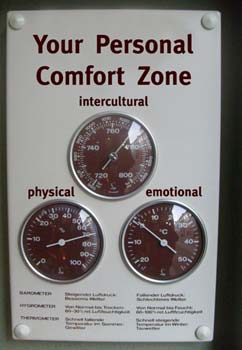
absolutely intercultural 129 +++ comfort zones +++ dangerous situations +++ scary moments +++ classical artist +++

your comfort zoneWelcome to show 129 of our Podcast “absolutely-intercultural”. Thanks you again to all of you who have helped us win in the non-profit category of the European Podcast Awards (fourth place in Germany and even number 1 in Denmark!). We really appreciate all your input and the attention our podcast has received as a result. We feel absolutely comfortable seeing that what we produce seems to have a wide audience of listeners.

absolutely scared
Today we are going to talk about comfort zones and especially leaving our comfort zones. A comfort zone is the place where you feel comfortable, where everything seems to be easy and under your control. But what happens if you have to leave this comfort zone because of a change in your life or if you decide out of your own free will to leave your comfort zone? In our first category I had a meeting with people who have chosen to spend some time outside their comfort zones – by going to a foreign country: Lucy from Australia, Gintare and Vaida from Lithuania and Yasha from Turkmenistan decided to leave their comfort behind and experience something new. They left their home countries and entered a new world. I asked them which situations in their new lives were the scariest.

absolutely dangerous
If the feeling is strong, you may even feel out of place or unsafe in your new environments. This happened to Beatrice, when she went to Egypt on a holiday for the first time and all the new impressions, smells, the loudness of the street and the different behaviors of people she met, made her feel like a fish out of the water and she was even a little scared. In our second category I asked whether she could still remember leaving her comfort zone for the first time.

absolutely prepared
In our next category I will return to our round table, where the foreign students tell me how they try to introduce familiar objects from their home countries into their unfamiliar surroundings in order to be a little more comfortable even outside their comfort zones. But first I asked the participants to tell me what situations in their host country made them most uncomfortable.

absolutely comfortable
When I was putting together this podcast it seemed that nowadays it is a universal truth that we need to leave our comfort zones all the time? But can that really be right? I went out of my way to find someone who says that there are professions where everybody would want you to stay within the comfort zone. How ironic, I actually had to find an artist who would speak in favor of comfort zones so in our fourth and last category I finally spoke to Paul MacAlindin, a classical musician who is active in organizing international orchestra performances, e.g. for the National Youth Orchestra of Iraq, of which he is the Musical Director. I asked him where he leaves his comfort zones during his artistic work and also in his private life. To my surprise he explained that in classical music most stakeholders prefer not to leave their comfort zones.

Our next show will be coming to you from Anne Fox in Denmark on 05  March

Until then –
Bleiben Sie absolut interkulturell!

The host of this show is: Dr. Laurent Borgmann
Editor: Dino Nogarole

absolutely intercultural 127 +++ e-mail addicted +++ communication guide +++ social media +++ digital media +++

Today we are going to talk about how important social media and email have become in our lives. Do they help us be more productive or do they dominate our daily lives? 2010 may have ended peacefully and the holiday season was pretty calm but what was your first look at the internet like when you came back to work? Hundreds of email messages that were waiting for an answer? Dozens of requests to join somebody’s Linked-In network or to accept or decline messages because you are the moderator of a list or a blog? To be honest, after 10 minutes at the computer where I felt like a fire-fighter trying to get the worst catastrophies under control I was tempted to shut down the computer and do some “real work”. But did I? No, somehow I felt I needed to write quick answers, press “Like” butt0ns on Facebook and accept digital invitations because it all looked so urgent and real even though I was alone in my office and all the urgency was “only digital”.

absolutely addicted
I met Elaine and Will and had a discussion about how to monitor your work-life balance and perhaps separate your business and your private lives. In this respect almost all my friends fall into one of two very separate cultures and will explain to you that their particular work situation (rather than their own choice) determines their behavior. Are you the kind of a person who will switch off totally after work and recharge your batteries so that you can perform well in the work place afterwards? Or are you always connected and keep checking your email account at home even when you should be preparing dinner? If you decide not to look at your work email at home, does that this really mean that you are less than fully committed to your job or does the constant digital connection to your work place show that you cannot let go and eventually lead to burn-out syndrome? However we deal with this, most of us somehow have a bad conscience about our work-life balance one way or another, so let us discuss this and see whether digital addiction is actually a bad thing? In our first category Elaine and Will describe how two partners deal with this daily challenge in very different ways.

absolutely professional
In our second category Andreas Faulstich tells our interviewer Maria that some badly written email messages can drive him crazy and cause him a lot of extra work. Fortunately, there are only few messages which steal his time. Listen to how he tries to deal with these messages and how he suggests writing email messages more professionally. First, Maria asked Andreas how many email messages he receives every day?

absolutely connected
In our last category we organized a round table where I am talking with Lucy, Emese and Markus about how students who leave their home universities and study abroad can stay connected with family, friends and their home university through the digital media. Do we perhaps need to choose different channels for different target groups?

Our next show will be coming to you from Anne Fox in Denmark on 04. February

Until then –
Bleiben Sie absolut interkulturell!

The host of this show is: Dr. Laurent Borgmann
Editor: Dino Nogarole

absolutely intercultural 121 +++ intercultural meetings +++ round table +++ positive thinking +++

intercultural meetingsToday our topic is about intercultural meetings and I have a co-host, Lucy, from Australia. Maybe some of you remember her from one of our last shows, in which I interviewed her about her first impressions of Europe. She is doing an internship at Rhein Ahr Campus in Remagen and has agreed to help our editor Dino and me with this episode.

absolutely adversarial
Do you often take part in meetings? Do you like meetings or do you think they are a waste of time? Have you ever taken part in an international meeting, with participants from all over the world? If you have and if you had no problems, congratulations – you are perhaps a natural talent? For those of you who never had the chance to participate in such a meeting, let me tell you, it can be full of traps and dangers.  Imagine a room with people from 6 or 7 different countries, that means 6 or 7 different cultures and different working habits. Now you can imagine that such a meeting can be a challenge for all participants. At a round table discussion Lucy, Dino and I discussed some topics relating to taking care and being aware of different attitudes in meetings.

absolutely international
Try to remember meetings in your own culture. What is the predominant style for finding the truth or for taking a difficult decision? Do participants seem to “fight each other” with words and arguments like lawyers in an adversarial system or are you used to the consensual approach which concentrates more on the common ground between different opinions and not so much on the differences?
Let us include two more cultures in this. Nicole is from Austria and Thomas from the Czech Republic. They shared with me their experiences of meetings. Sometimes you have to spend all day in project meetings with your colleagues, and after the meetings you may want to be on your own.

absolutely well prepared
Now for the second part of the round table. Controversies within a meeting are discussed as well as which document is needed, what preparation needs to be done and what the perfect duration of a meeting is. Also, stay tuned to find out how  Lucy picked on a poor German girl during one of my meetings… If you only remember one thing from this podcast let it be this piece of advice – make sure you are mentioned in the minutes after a meeting, otherwise it’s like you were never there!

Our next show will be coming to you from Anne Fox in Denmark on 12. November

Until then –
Bleiben Sie absolut interkulturell!

The host of this show is: Dr. Laurent Borgmann
Editor: Dino Nogarole

absoutely intercultural 119 +++ Australian impressions +++ Erasmus life +++ Turkish challenge +++

Australian Intern Lucy Warren at RheinAhrCampusMerhaba, welcome, and iyi günler. Yes, I have learned some basic Turkish and took part in a beginners’ language course. Why did I do that? Well, here in Germany we have important Turkish communities in our big cities, so my idea was to learn more about their language and their culture.
G’day from down under! I also want to present Lucy! Lucy is one of our new members in the international team of the Rhein AhrCampus in Remagen. She is from Australia and over the next months we might hear more from her if she decides to help us with this podcast.

absolutely up-above
As you know, every year we have a number of international students, who visit us to spend a semester or two at our university. One of our newly arrived incoming students is Lucy Warren from the University of the Sunshine Coast. She is half Australian and half South African. So I asked her about the first impressions she had after her arrival and what differences she has noticed in Europe. Perhaps we will be able to convince Lucy to keep us up to date with her intercultural discoveries throughout her stay over the next months? In our first category she told me her stereotypes about Europe and the very first impressions she gained.

absolutely changed
I took an interview with Maria Koehnen. She spent a semester in Belgium where she met a number of international students from all over the world. She explained to me how to get an ERASMUS scholarship and stressed the advantages of a semester abroad. So, how can one semester abroad change you so much?

absolutely challenged
A couple of weeks ago I created my own challenge. I took part on an intensive Turkish language course at Netzwerk Deutsch in Cologne for one week. Many friends and colleagues asked me “Why Turkish?” and it is true that as I have learned English, Latin, French and Italian at school and at university, it would have been a little more plausible to learn Spanish for example. And clearly this would have been a lot easier for me! However, in our private and professional lives we are surrounded by people from all over the world, with different languages and different cultures. On my way to our supermarket I actually meet more people who can speak Turkish than people who can speak English as I live very close to a Turkish community in Cologne. So my aim was to learn more about this culture and now I am proud to say, that when I went to my Turkish corner shop last week, I managed to do the small talk in Turkish. I am amazed at the reactions, shop keepers immediately turn into friends. It is almost as if I was the first person they have met who has learned a little bit of Turkish just for my social life. I must admit though that learning Turkish was the hardest thing I have ever learned in my whole life and in our third and last category I talked with participants and the teacher of my Turkish course, and we tried to find out, why people choose or reject the challenge of learning Turkish.

Enjoy listening to our show no. 119

Our next show will be coming to you from Anne Fox in Denmark on 15.October

Until then –
Bleiben Sie absolut interkulturell!

The host of this show is: Dr. Laurent Borgmann
Editor: Dino Nogarole

absolutely intercultural 117 +++ Chinese food +++ Belgium habits +++ Hong Kong adventure +++

http://www.flickr.com/photos/fortes/279647509/sizes/m/in/photostream/

Let us  take you on a culinary audio-trip to China and Belgium. Yes, let us talk about food! In previous shows we’ve talked about going abroad, about culture shocks and the different habits in foreign countries. But apart from the language and the attitudes of the other culture, what about the local cuisine? What happens if you travel to a country in which you don’t know anything about the food culture? Can you prepare yourself for such a situation before you leave?

absolutely different
I am not sure whether you have seen the film Julie and Julia which is all about food and preparing food and eating food and cultural differences between food in America and food in France. If you have not seen the film, please put it at the top of your list of films to see because it is full of little intercultural gems and Meryl Streep is just incredible in it. In the film Meryl Streep plays Julia Child, an American who is the wife of a diplomat in Paris and falls in love with the French way of cooking. She decides to introduce the French cuisine to the American housewife of the fifties by writing the book “Mastering the Art of French Cooking”
Now, what about you? What are you like? When you travel to a foreign country, where you have a totally different cuisine from home? I asked Mingxia, one of my business students from China, if the food offered in Chinese restaurants in Europe is the same as food offered in China.

absolutely fun
When we talk about countries like China we expect a big difference in food habits, but how about our European neighbors – for example the Belgians? Normally we would think that we have a lot in common, but Filip Dedeurwaerder told me that even the time we spend eating our food is very different. For example, while in Germany we often only take half an hour to eat during our lunch break, the Belgians take much more time to celebrate their food and are allowed to have a glass of wine with their lunch. So, eating and drinking habits seem to be very different even with our closest neighbors.

absolutely adventurous
Carina Mayer, a student from the RheinAhrCampus in Remagen, did an internship in Hong Kong, searching for a cultural change and new experiences. She gives us some insights into her experiences with the Chinese cuisine. It seems that she was eager to try everything that the Chinese put on her plate. She often went out to try out and enjoy the variety of the Chinese cuisine with her colleagues. Carina is really adventurous and was looking for a totally new experience and that was exactly what she got.

Our next show will be coming to you from Anne Fox in Denmark on 18.September

Until then –
Bleiben Sie absolut interkulturell!

The host of this show is: Dr. Laurent Borgmann
Editor: Dino Nogarole

absolutely intercultural 115 +++ academic integration +++ incoming students +++ buddy system +++ cultural diversity +++

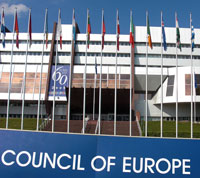
Council of Europe by "notfrancois" on FlickrWhat can universities do to integrate foreign students interculturally? The Council of Europe’s White Paper on Intercultural Dialogue demands that “Higher-education institutions play an important role in fostering intercultural dialogue, through their education programmes, as actors in broader society and as sites where intercultural dialogue is put into practice”. So, let us look at how this political demand is put into practice by talking to both, students and experienced professionals who are responsible for integrating foreign students in universities.

absolutely welcome
The Steering Committee on Higher Education and Research suggests, that “the university is ideally defined precisely by its universality – its commitment to open-mindedness and openness to the world, founded on enlightenment values. The university thus has great potential to engender ‘intercultural intellectuals’ who can play an active role in the public sphere”.
So let us do a reality check and find out how this open-mindedness and openness of the universities is put into practice in real life. Which methods are used to integrate incoming students in the daily academic life in the foreign country? I spoke with Adelheid Korpp, who is responsible for the incoming students at RheinAhrCampus in Remagen. In our first category, she told me what methods are used for facilitating intercultural integration for the foreign students. In fact, her services starts long before the students arrive in Germany.

absolutely helpful
One of these student mentors is Tobias Pfanner who has worked and studied in Canada and Australia and from his own experience he already knew how important intercultural mentors can be at the beginning of your stay abroad. He told me the story, how he took the decision to be a “buddy” and help a foreign student have a good start in Germany.

absolutely Spanish
Are these methods of integration the same in different universities? Our student editor Dino spent a semester in León in Spain. In our next category he explains what our partner university did to integrate foreign students interculturally and help them network with each other. Do they also use a “buddy system”?

absolutely integrated
Unfortunately, not every stay abroad is well prepared and crowned with academic success stories. In our next category I asked Adelheid what happens if the intercultural integration does not work as well as we have heard in our previous stories? Do international students sometimes turn up in the international office in tears because they cannot make friends or because they cannot follow the academic courses in the foreign language?

absolutely flexible
In our last category, David shares his intercultural experiences at the university in Russia. Of course he he was prepared for seeing different behaviours even for facing situations which in his home country are unthinkable. However, even though he was well prepared for his stay in Russia the attitude of showing “flexibility in exams” reserved some culture shocks for him and the other foreign students. In my conversation with David we also talked about the role of the new social media for getting in contact and staying in contact with your new intercultural acquaintances after your stay abroad. However, in different countries students use different social media to get in touch and keep in contact.

Our next show will be coming to you from Anne Fox in Denmark on 21 August

Until then –
Bleiben Sie absolut interkulturell!

The host of this show is: Dr. Laurent Borgmann
Editor: Dino Nogarole
absolutely intercultural 113 +++ infected with the travel bug +++ daad go-out! campaign +++ strategic internationalisation +++

Today the whole show is dedicated to the go-out campaign, of BMBF and DAAD, the German Academic Exchange Service, which encourages young people to spend a semester abroad. I spoke to students and organisers and asked them how to plan your stay abroad,  which skills are needed and what benefits we can expect to get out of it. They told me what reasons motivated them to plan this big step in their careers and but also in their private lives and which intercultural experiences they have made abroad.

absolutely infected
Making intercultural experiences abroad is becoming more and more important for our working lives. It is generally agreed that students should pack up, leave everything behind, discover the intercultural world and learn about new cultures at least for one semester. I met a student who has done this more than one time. In our first category we hear how Tobias Pfanner went to Canada and after this experience he also did an exchange semester at our partner university in Australia. Right now he is applying for a scholarship to do his internship in China. But let us listen to how it all began during his first weeks on campus.

absolutely going out
In our next category I spoke with Wolfgang Kreft, from the go-out campaign of the DAAD, the German Academic Exchange Service. He told me how they tour from city to city – from university to university park their mobile stand with information in the middle of the campus they visit and try to convince students to make that big step and study abroad. I must say I am a great fan of the go-out campaign of the DAAD that reaches out to the students where they are – in the middle of their campus and sends out the clear signal that going abroad is not reserved to the best students and certainly not only to the richest students but should be an aim for everybody. On our campus this has inspired many students to find out more about our partner universities and scholarships and to visit the international office to get more information

absolutely strategic
In our next category, I interviewed David, a student who has made internationalization a priority and has studied and worked in Germany, Hungary, Ireland, Russia, and in Great Britain – no wonder he is strategically planning to join the diplomatic service after his studies.

absolutely german
In our last category I did an interview with Dino, who is the student editor of this podcast and who has just come back from his experience abroad. He spent a semester at our partner university in Spain and told me what motivated him to make his own intercultural experiences abroad.

Our next show will be coming to you from Anne Fox in Denmark on 23 July

Until then –
Bleiben Sie absolut interkulturell!

The host of this show is: Dr. Laurent Borgmann
Editor: Dino Nogarole

absolutely intercultural 111 +++ Football World Cup +++ Theater der Welt +++ stereotypes +++

Theater der Welt
Theater der Welt - first production 30 June

Today, Friday 11 June 2010, the world’s eyes are on the start of the Football World Cup in South Africa, in which people from so many different nations will meet each other and confront different cultures. Listeners across the world, please keep your fingers crossed that this World Cup in Africa will become a memorable intercultural event!
I must admit – I am not even a football fan, and certainly no specialist, but I thought I have to make an effort and speak about football today, about stereotypes, about cultural misunderstandings and linguistic challenges connected with big international events – not just football but also cultural events. I talked with people from Belgium, England and Spain, to see what kinds of experiences they have made in intercultural communication.

absolutely confused
As you all know, today the Football world cup in South Africa starts and I’m sure that most of you can’t wait to see your favorite team win. Have you noticed that while we think of these international events are great intercultural meeting places, international football matches often give rise to a lot of terrible stereotypes? These are moments when fans dig deep and sometimes come up with very unpleasant clichés. English tabloids sometimes use war metaphors to describe the German teams in a contest. I called Jean, a friend of mine who moved from Manchester to Bonn years ago. In our first category she tells us how those terrible old stereotypes always come up again when there is an international football event.

absolutely ambiguous
Now, two days ago, I was very lucky and was able to get a personal interview with an incredibly interesting person. Frie Leysen is the Programme Director of the “Theatre of the World” Event and came to Cologne to share her vision of this great international event of performing arts with us. While many of us interested in intercultural communication try to reduce ambiguity by finding cultural explanations for differences and theories for coping with unwanted loss of orientation, Frie does the opposite. She invites more than 30 of the most interesting theatre productions to one location in order to force the audience to embrace ambiguity and misunderstandings.

absolutely perplexed
Some time ago I met Marlen from Spain who had spent some time in Germany and she shared with us the cultural differences which exist between Spain and Germany. In our next category we’ll hear what experiences Marlen made with German men in the streets and how she learned to handle them.

absolutely proud
Now let us come back to Jean, with whom I continued the football conversation about the psychological problems Germans used to have with their national pride after the war and the taboo of private flags. Now, this changed a lot during the World Cup in Germany in 2006 when at least the younger generations put these taboos behind them and behaved like youngsters all over the world. And now, before the world cup starts we can see this again. Suddenly, it seems acceptable to put a flag in your window or even on your car. In our last category Jean is divided whether flags and partiotism should be seen as right or wrong.

The next show will be hosted by Anne Fox in Denmark on 25 June

Until then –
Bleiben Sie absolut interkulturell!

The host of this show is: Dr. Laurent Borgmann

Editor: Dino Nogarole
Podcast-Feed

iTunes-Abo

absolutely intercultural 110 +++ the world at work +++ Debbie Swallow +++ Language Learning & Social Media +++ Pilbeam +++

By Boby Dimitrov

absolutely worth it
Thank you to Valentina Dodge for nominating the podcast and blog as one worth taking a look at. Thanks Valentina and now I just have to compile our own list of blogs worth looking at. I’ll be doing that in time for the next show but in the meantime you’ll hear about a great nomination in today’s show.

absolutely diverse
Now what were you doing last Friday? I’m asking because it was a special day for people interested in intercultural matters and Debbie Swallow from the UK is going to tell us more. I really do recommend a visit to the new theworldatwork blog in honour of UNESCO’s World Day for Cultural Diversity, for Dialogue and Development.

absolute textbook
It’s often said that you can’t learn a language without culture so it makes sense to bring out a book which helps you learn English through learning about intercultural matters. I was at the IATEFL conference in Harrogate in April where I met Adrian Pilbeam, the author of the new book Working across Cultures, and discussed it with him. The book is part of the Pearson Longman Market Leader series and could be a useful supplement to the main course text.

absolutely social
Now we’ll hear from Fred Dervin in Finland about why he was involved in organising a webinar about social media and inclusion and quite what this has to do with culture. The online conference took place in late April about the potential of social media, such as this podcast or our blog, to reduce social exclusion. The event was part of a large European project Language Learning and Social Media which will be coming up with best practices. You’d be surprised how much social exclusion has to do with cultural differences. In her session Professor Ruth Illman from Finland presented us with some different metaphors for culture. Prof Illman’s then moved on from talking about boxes to something more flexible. In the webinar we also  heard about some problems in Second Life, the virtual world where one of the things you have to do is to choose an avatar or representation of yourself which you can then clothe according to your preferences. Prof. Gráinne Conole from The Open University, UK explains. 

Don’t forget that you can still vote for us in the European Podcast Awards both on the German page and the Danish page.

The next show will be coming to you on 11 June from Dr. Laurent Borgmann in Germany.

So long…stay tuned!

The host of this show is: Anne Fox
Editor: Dino Nogarole

absolutely intercultural 109 +++ go-out campaign +++ DAAD & BMBF +++ be prepared +++


Today I would like to introduce you to the “Go-Out” Campaign of the German Academic Exchange Service and the German Ministry of Education and Research.
Both institutions have formed an alliance to increase the percentage of German students who spend time abroad during their studies. The aims include studying abroad, doing an internship abroad, writing your Bachelor or Master thesis abroad or following language courses abroad. One of the aims is also to encourage students to look beyond Europe and spend some quality time in Asia, Latin America, or Africa in order to round off their studies in Germany. Please visit the web page of the Go-Out campaign at www.go-out.de. Please have a look at the profiles of former outgoing students such as Birgit and Siegfried who studied in Israel and China.

absolutely connected
Today I will invite you to listen to students from the University of Applied Sciences, Koblenz, RheinAhrCampus, who have already been abroad or are planning their stay but also to professionals from the international office who share their experiences with us and can perhaps whet your appetites for such a stay abroad.
How should you prepare for your stay abroad? Why do German employers think that if you have spent some time abroad you will be a better employee? Let us try to find out why your stay abroad will be a unique opportunity. A stay abroad during your studies is certainly a valuable extra for your career planning. Your experience abroad, whether study or internship, will help you develop and round off your personality but will also provide impressions and insights which perhaps others will envy you later. Many job advertisements nowadays list the requirement “experience abroad”, even if the job itself does not seem to require international contact.

absolutely representative
Before and during their stays abroad students are often not really aware of what the real benefits of their experience will be. This will only show years later. And sometimes students unfortunately give up their plans because they cannot imagine where they should get the extra money from, whether they can survive with their basic English, or whether they should really leave their friends and family behind for several months. When you have these doubts, you should not give up but ask for help from your university. In this category I spoke to Andreas Faulstich who is responsible for the language program at RheinAhrCampus of the University of Applied Sciences, Koblenz. I asked him how many of his students do actually go out to study or do an internship abroad. And what keeps those who decide against it from seeking that valuable experience? Is it always the extra costs that students may have to shoulder?

absolutely prepared
So let us turn to our next step, the preparation for a stay abroad. Some time ago I interviewed Carsten just before he went to Great Britain to do his practical training He is from a little village near the university and put a lot of effort into preparing himself for his practical training abroad and, as a consequence, managed to secure a scholarship for himself under a program called ERASMUS Placements. One of Carsten’s aims is to “grow up” through new personal experiences.

absolutely shocked
How can students find out what exactly needs to be prepared before they take their decisions and hand in their applications? At every university in Germany students will find help with these questions in the international office. In our last category I asked Barbara Neukirchen who works for the international office how early she needs to get in contact with students to prepare them strategically for their stay abroad.

The next show will be hosted by Anne Fox in Denmark on 28 May

Until then –
Bleiben Sie absolut interkulturell!

The host of this show is: Dr. Laurent Borgmann
Editor: Dino Nogarole