
absolutely intercultural 139 +++ Kurds and Arabs +++ Iraq +++ NYOI +++ Spiritual Journeys +++ Migration +++

In this show we will talk about: religious intercultural exchange and especially the famous Catholic event  “World Youth Day”, a New Zealander who traveled the world and found the most unusual souvenir in Peru (his wife), and I will take you behind the scenes of the inspiring project – the “The National Youth Orchestra of Iraq” which we already heard about in our last shows.

absolutely unexpected part I
We heard from the Scottish conductor Paul MacAlindin himself, from tutors who are supporting the orchestra by teaching different musical instruments and even from students at RheinAhrCampus who helped promote the project through social media such as Facebook and YouTube. This time, in our first category  we will hear more about the intercultural differences, the language barriers and the everyday challenges of the “National Youth Orchestra of Iraq”. I talk with Karl-Walter Keppler, the chairperson of the sponsorship association which is organising financial support for the Iraqi musicians so that they can travel to Europe to perform in the Beethovenfest in Germany. Karl-Walter has first-hand intercultural experiences as he, himself, travelled to Iraq last year.  But what are the motivations behind his involvement in the project?

absolutely spiritual
In our second category  I talk to a student from RheinAhrCampus, Denise Wagner, who is perhaps a little different from other students. Most students nowadays are not very religious. Or if they are, we don’t really notice. However, Denise is an exception. She is an active Catholic and likes to do pilgrimages and so she has traveled to many spiritual places – for example the Greek Island Pathmos. Her next destination will be the “World Youth Day” which is going to take place in Spain later this year. But is she doing this on her own? And what exactly happens when she arrives at these places? Is this about fasting with bread and water in a monastery or about dancing around campfires and playing the guitar?

absolutely unexpected part II
In this category I want to come back to the interview with Karl-Walter Keppler. In this part he gives us insights into the specific work on the project. So what is his foundation doing for the orchestra? Without this support the Iraqui musicians would not be able to pay for their travel to Europe. Karl-Walter is going to tell us about the status quo of the project! Where are they at the moment, what they need and what is going to happen in the future?

absolutely migrated
In our last category  Mathew Dunne will share some of his life experiences with you. He is originally from New Zealand, but travelled the world until he met his wife in Peru on a holiday. He loves to leave his comfort zone and travel to unique destinations, but he may have different motivations… On these journeys, Mat has experienced a lot more than most of us. Mat is not just traveling as a holiday maker – he has lived in most of the countries he visited for a longer period of time and even worked there. He will tell us about his motivations and his specific experiences he gathered while working as plumber in London.

Our next show will be coming to you from Anne Fox in Denmark on 22 July

Until then –
Bleiben Sie absolut interkulturell!

The host of this show is: Dr. Laurent Borgmann
Editor: Markus Scherer

absolutely intercultural 137 +++ National Youth Orchestra Of Iraq +++ Marketing Project +++ New European Mobility Law +++

The National Youth Orchestra of Iraq” is an inspiring project led by musical director Paul MacAlindin which  is going to play in Bonn, Germany, on 1 October in the context of the Beethovenfest. In show 135 I interviewed Paul about the project itself. Now  I am talking to some of the supporters of his project. On the one hand there is Prof. Karin Wolf, who plays the violin and is helping the players to improve and on the other hand there are two students from RheinAhrCampus who are also playing their role in the project.

absolutely open
Karin Wolf, a professor of viola, will share her experiences with us.  She tried to collect musical instruments for the orchestra. Karin asked at her school whether people would have instruments which are no longer used and which could be donated to this international project. Furthermore she supported Paul and now she is helping the viola players to improve. In this interview she will share her motivation with us and the reasons why she is taking part in the project.

absolutely professional (part I)
Lucy Warren, our committed exchange student from Australia and co-worker in the International Office, will interview Nadya Kokareva from Russia. They are both involved in the “National Youth Orchestra Of Iraq” project.  Nadya is also a participant of the university course “International Business Simulations” at RheinAhrCampus. Nadya will tell us in a first part how quickly her university course and the simulated company turned into a realistic one with a customer, what the students are doing for this customer and how they support the “National Youth Orchestra of Iraq”.

absolutely political
I would like to share a commentary given by one of my university colleagues about a political change which has affected Europe during the last few months. Two students from RheinAhrCampus, Marc Friedrich and Andrea Edel, interviewed Heinz Schaumann a university lecturer and expert in European institutions and law. Marc asked about the newest political developments in Europe; the recent changes in mobility law which were widely discussed in Germany. The countries in Europe have gradually opened their borders to the labor market. Especially those countries which followed the 2-3-2 rule are now the focus of European attention. This rule was made to somehow protect the labor markets of Western European countries for 7 years from workers migrating from East to West. Heinz Schaumann is in a very good position to give us a report about what happened and about the future prospects, for example the advantages and disadvantages for the “old” countries of the European Union.

absolutely professional (part II)
The Arabic and Kurdish players of the orchestra will  leave their country in September, albeit, only for a short period of time and will travel to Germany. They will  have to abandon their intercultural comfort zones by leaving  their home country and coming to a foreign country with a very different culture, to play music in a multi-ethnic orchestra. In our last category  Nadya tells us in the second part of the interview what specific role she held in the project and in the simulated company and what YOU, the audience, could do, to support the Orchestra, too! If you are interested in the way the exchange students are involved in the project, you can also follow them on their blog.

Ways to support “The National Youth Orchestra of Iraq”:

YOUTUBE: 1. NYOI plays for kids, 2. General Information, 3. KICKSTARTER

FACEBOOK: 1. German, 2. International
We hope we can motivate some of you to help support the “Youth Orchestra” with their project and their trip to Europe!

Breaking News: Saudi Arabian women want to be allowed to drive on their own! You can get to know something about their situation on Youtube and on their blog! Enjoy!

Our next show will be coming to you from Anne Fox in Denmark on 24 June

Until then –
Bleiben Sie absolut interkulturell!

The host of this show is: Dr. Laurent Borgmann
Editor: Markus Scherer

absolutely intercultural 135 +++ new editor +++ national youth orchestra +++ reunion of two sisters +++

Dino, our previous editor, is not working for this podast any longer. He finished his studies and right now he is doing an internship as a controller in a company in Switzerland! The team of the international department at RheinAhrCampus wishes him the best in his future. Dino was the most international of us and he jokingly introduced himself as half German, half Italian and half Swiss. We all know that Dino has the potential to go very far and wish him the best!

absolutely new
But who is going to help us with the podcasts? I have the pleasure to present you his successor: Markus Scherer. You may know him from interviews in previous shows. Dino made sure there was a smooth transition and taught Markus all the tricks of the trade so that you, the listeners, will hopefully not even notice any difference in quality. Markus is a student at RheinAhrCampus and in our first category  Emese and Lucy are trying to find out everything about his hobbies, interests and fears.

absolutely open-minded
I am talking to Paul MacAlindin the Musical Director of the National Youth Orchestra of Iraq and his flautist Daniel Agi about their new music project in Iraq in our second category. What happened when they tried to start an orchestra in an Arabic country recovering from a war? Imagine if you have to create an intercultural team consisting of multi-lingual and multi-cultural and multi-religious participants. Perhaps even people who outside your team would never choose to talk to each other – like Kurdish and Arabic participants. How difficult must that be? Paul MacAlindin created the National Youth Orchestra of Iraq which can also be followed on facebook. He will tell you more about his project and the hurdles he has to take. Furthermore Daniel Agi will share his experiences how he supported the flautists during the rehearsals in Iraq.

absolutely coincidental
In our last category you will learn about an unlikely reunion of two sisters. Both have the surname “Bognar”. One grew up in Germany, the other in Hungary. When the German sister wanted to learn Hungarian her teacher matched her with another student who is also called “”Bognar”. This story is too sweet to be true! But how could that happen? Well, Emese is from Hungary and working for the international department here at RheinAhrCampus– and Daniela is German and a student at RheinAhrCampus. They both met for the first time here on campus. But are they related? This is what Lucy is going to find out and at the same time we learn more about the differences of everyday life in Hungary and Germany

Our next show will be coming to you from Anne Fox in Denmark on 27 May

Until then –
Bleiben Sie absolut interkulturell!

The host of this show is: Dr. Laurent Borgmann
Editor: Markus Scherer

absolutely intercultural 133 +++ different skin colours +++ adoption +++ integration of black children +++ children confronted with racism +++

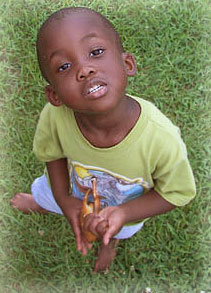
black-boy CG2_SoulArtist on flickrWhat pictures would you have in your minds when we are talking    about people who are visibly different? Perhaps the difference could have something to do with their skin colour? In fact, today I present some exciting interviews for you with people who have children with a different colour.

absolutely integrated
Christiane Bainski, adopted a black youngster who was a pupil in her school class. Of course, this was not the typical way to adopt a child –  the idea actually came from Busa himself, her pupil, who was taught by Christiane. Can you imagine how Busa convinced his teacher to adopt him? It was a big step for both, teacher and pupil – but the administrative side was less complicated than expected. Let us listen to Christiane’s report. 

absolutely mysterious
Iris Hansen, also a white woman has three beautifully coloured children. However, her husband is also white. So the obvious question is:  “Where does all the  colour of the children come from?” Sounds mysterious? Could it have anything to do with the fact that Iris’ husband likes dark chocolate as he sometimes jokingly suggests?

absolutely adopted
Paul Masson is also the father of a coloured boy.  He tells us that Mathieu, his black son, sometimes misinterpreted stereotypes about black people he heard when he was young. For example one time he got really worried when at school he learned that black children do not get enough to eat …

Our next show will be coming to you from Anne Fox in Denmark on 29 April

Until then –
Bleiben Sie absolut interkulturell!

The host of this show is: Dr. Laurent Borgmann
Editor: Markus Scherer

Continue reading “absolutely intercultural 133 +++ different skin colours +++ adoption +++ integration of black children +++ children confronted with racism +++”

absolutely intercultural 131 +++ changing perspectives +++ annoying behaviour in class +++ hospitality club +++ freezing in Australia +++

Why do different people have different perspectives? How can the same person have different perspectives on traffic only because one time the person experiences it in the car and the next day on a bicycle? How do our perspectives on events change over time. How big is the cultural influence on our perspective? And how does our perspecive change when we move to another culture?

absolutely changed
All of us have different perspectives on the everyday things that surround us, we watch news on television, hear stories and we think we are perfectly informed about everything. But are we really? Sometimes a trip to another country or a new episode in our lives can change our perspective on the World dramatically.
Take Paul MacAlindin for example. He moved from small-town Scotland to big-town Germany and this move changed his geographical perspective to one which for Continental Europeans seems very normal.

absolutely irritating
Emese Bognar an exchange student from Hungary, vividly illustrates different perspectives and changing perspectives when she told me what irritated her when she attended a lecture and how her perspective on traffic changed, when she did her driving license.

absolutely hospitable
Agnes Dus from Hungary interviewed Adelheid Korpp, who had tried the “hospitality club”, which is a clever system for travelers to get cheap accommodation. The traveler applies for accommodation to a host, contacts the host and asks if they can stay for 1 or 2 nights. This seems to be a pleasant way for travelers to get around and have a cheap bed for the night. However, more importantly, this could be a good way to change your perspective from that of a regular tourist to that of a dear friend invited to the country. But let us listen to Adelheid how this works in detail, because first of all you need to get approved.

absolutely freezing
In our fourth and last category Roman told me about his time in Australia; he spent a semester at the University of the Sunshine Coast in Queensland and we now really have to change our perspectives here, because he is telling us that in the middle of the Australian summer you can still feel pretty cold, but listen to him yourself.

Our next show will be coming to you from Anne Fox in Denmark on 01 April

Until then –
Bleiben Sie absolut interkulturell!

The host of this show is: Dr. Laurent Borgmann
Editor: Dino Nogarole

absolutely intercultural 129 +++ comfort zones +++ dangerous situations +++ scary moments +++ classical artist +++

your comfort zoneWelcome to show 129 of our Podcast “absolutely-intercultural”. Thanks you again to all of you who have helped us win in the non-profit category of the European Podcast Awards (fourth place in Germany and even number 1 in Denmark!). We really appreciate all your input and the attention our podcast has received as a result. We feel absolutely comfortable seeing that what we produce seems to have a wide audience of listeners.

absolutely scared
Today we are going to talk about comfort zones and especially leaving our comfort zones. A comfort zone is the place where you feel comfortable, where everything seems to be easy and under your control. But what happens if you have to leave this comfort zone because of a change in your life or if you decide out of your own free will to leave your comfort zone? In our first category I had a meeting with people who have chosen to spend some time outside their comfort zones – by going to a foreign country: Lucy from Australia, Gintare and Vaida from Lithuania and Yasha from Turkmenistan decided to leave their comfort behind and experience something new. They left their home countries and entered a new world. I asked them which situations in their new lives were the scariest.

absolutely dangerous
If the feeling is strong, you may even feel out of place or unsafe in your new environments. This happened to Beatrice, when she went to Egypt on a holiday for the first time and all the new impressions, smells, the loudness of the street and the different behaviors of people she met, made her feel like a fish out of the water and she was even a little scared. In our second category I asked whether she could still remember leaving her comfort zone for the first time.

absolutely prepared
In our next category I will return to our round table, where the foreign students tell me how they try to introduce familiar objects from their home countries into their unfamiliar surroundings in order to be a little more comfortable even outside their comfort zones. But first I asked the participants to tell me what situations in their host country made them most uncomfortable.

absolutely comfortable
When I was putting together this podcast it seemed that nowadays it is a universal truth that we need to leave our comfort zones all the time? But can that really be right? I went out of my way to find someone who says that there are professions where everybody would want you to stay within the comfort zone. How ironic, I actually had to find an artist who would speak in favor of comfort zones so in our fourth and last category I finally spoke to Paul MacAlindin, a classical musician who is active in organizing international orchestra performances, e.g. for the National Youth Orchestra of Iraq, of which he is the Musical Director. I asked him where he leaves his comfort zones during his artistic work and also in his private life. To my surprise he explained that in classical music most stakeholders prefer not to leave their comfort zones.

Our next show will be coming to you from Anne Fox in Denmark on 05  March

Until then –
Bleiben Sie absolut interkulturell!

The host of this show is: Dr. Laurent Borgmann
Editor: Dino Nogarole

absolutely intercultural 127 +++ e-mail addicted +++ communication guide +++ social media +++ digital media +++

Today we are going to talk about how important social media and email have become in our lives. Do they help us be more productive or do they dominate our daily lives? 2010 may have ended peacefully and the holiday season was pretty calm but what was your first look at the internet like when you came back to work? Hundreds of email messages that were waiting for an answer? Dozens of requests to join somebody’s Linked-In network or to accept or decline messages because you are the moderator of a list or a blog? To be honest, after 10 minutes at the computer where I felt like a fire-fighter trying to get the worst catastrophies under control I was tempted to shut down the computer and do some “real work”. But did I? No, somehow I felt I needed to write quick answers, press “Like” butt0ns on Facebook and accept digital invitations because it all looked so urgent and real even though I was alone in my office and all the urgency was “only digital”.

absolutely addicted
I met Elaine and Will and had a discussion about how to monitor your work-life balance and perhaps separate your business and your private lives. In this respect almost all my friends fall into one of two very separate cultures and will explain to you that their particular work situation (rather than their own choice) determines their behavior. Are you the kind of a person who will switch off totally after work and recharge your batteries so that you can perform well in the work place afterwards? Or are you always connected and keep checking your email account at home even when you should be preparing dinner? If you decide not to look at your work email at home, does that this really mean that you are less than fully committed to your job or does the constant digital connection to your work place show that you cannot let go and eventually lead to burn-out syndrome? However we deal with this, most of us somehow have a bad conscience about our work-life balance one way or another, so let us discuss this and see whether digital addiction is actually a bad thing? In our first category Elaine and Will describe how two partners deal with this daily challenge in very different ways.

absolutely professional
In our second category Andreas Faulstich tells our interviewer Maria that some badly written email messages can drive him crazy and cause him a lot of extra work. Fortunately, there are only few messages which steal his time. Listen to how he tries to deal with these messages and how he suggests writing email messages more professionally. First, Maria asked Andreas how many email messages he receives every day?

absolutely connected
In our last category we organized a round table where I am talking with Lucy, Emese and Markus about how students who leave their home universities and study abroad can stay connected with family, friends and their home university through the digital media. Do we perhaps need to choose different channels for different target groups?

Our next show will be coming to you from Anne Fox in Denmark on 04. February

Until then –
Bleiben Sie absolut interkulturell!

The host of this show is: Dr. Laurent Borgmann
Editor: Dino Nogarole

absolutely intercultural 121 +++ intercultural meetings +++ round table +++ positive thinking +++

intercultural meetingsToday our topic is about intercultural meetings and I have a co-host, Lucy, from Australia. Maybe some of you remember her from one of our last shows, in which I interviewed her about her first impressions of Europe. She is doing an internship at Rhein Ahr Campus in Remagen and has agreed to help our editor Dino and me with this episode.

absolutely adversarial
Do you often take part in meetings? Do you like meetings or do you think they are a waste of time? Have you ever taken part in an international meeting, with participants from all over the world? If you have and if you had no problems, congratulations – you are perhaps a natural talent? For those of you who never had the chance to participate in such a meeting, let me tell you, it can be full of traps and dangers.  Imagine a room with people from 6 or 7 different countries, that means 6 or 7 different cultures and different working habits. Now you can imagine that such a meeting can be a challenge for all participants. At a round table discussion Lucy, Dino and I discussed some topics relating to taking care and being aware of different attitudes in meetings.

absolutely international
Try to remember meetings in your own culture. What is the predominant style for finding the truth or for taking a difficult decision? Do participants seem to “fight each other” with words and arguments like lawyers in an adversarial system or are you used to the consensual approach which concentrates more on the common ground between different opinions and not so much on the differences?
Let us include two more cultures in this. Nicole is from Austria and Thomas from the Czech Republic. They shared with me their experiences of meetings. Sometimes you have to spend all day in project meetings with your colleagues, and after the meetings you may want to be on your own.

absolutely well prepared
Now for the second part of the round table. Controversies within a meeting are discussed as well as which document is needed, what preparation needs to be done and what the perfect duration of a meeting is. Also, stay tuned to find out how  Lucy picked on a poor German girl during one of my meetings… If you only remember one thing from this podcast let it be this piece of advice – make sure you are mentioned in the minutes after a meeting, otherwise it’s like you were never there!

Our next show will be coming to you from Anne Fox in Denmark on 12. November

Until then –
Bleiben Sie absolut interkulturell!

The host of this show is: Dr. Laurent Borgmann
Editor: Dino Nogarole

absoutely intercultural 119 +++ Australian impressions +++ Erasmus life +++ Turkish challenge +++

Australian Intern Lucy Warren at RheinAhrCampusMerhaba, welcome, and iyi günler. Yes, I have learned some basic Turkish and took part in a beginners’ language course. Why did I do that? Well, here in Germany we have important Turkish communities in our big cities, so my idea was to learn more about their language and their culture.
G’day from down under! I also want to present Lucy! Lucy is one of our new members in the international team of the Rhein AhrCampus in Remagen. She is from Australia and over the next months we might hear more from her if she decides to help us with this podcast.

absolutely up-above
As you know, every year we have a number of international students, who visit us to spend a semester or two at our university. One of our newly arrived incoming students is Lucy Warren from the University of the Sunshine Coast. She is half Australian and half South African. So I asked her about the first impressions she had after her arrival and what differences she has noticed in Europe. Perhaps we will be able to convince Lucy to keep us up to date with her intercultural discoveries throughout her stay over the next months? In our first category she told me her stereotypes about Europe and the very first impressions she gained.

absolutely changed
I took an interview with Maria Koehnen. She spent a semester in Belgium where she met a number of international students from all over the world. She explained to me how to get an ERASMUS scholarship and stressed the advantages of a semester abroad. So, how can one semester abroad change you so much?

absolutely challenged
A couple of weeks ago I created my own challenge. I took part on an intensive Turkish language course at Netzwerk Deutsch in Cologne for one week. Many friends and colleagues asked me “Why Turkish?” and it is true that as I have learned English, Latin, French and Italian at school and at university, it would have been a little more plausible to learn Spanish for example. And clearly this would have been a lot easier for me! However, in our private and professional lives we are surrounded by people from all over the world, with different languages and different cultures. On my way to our supermarket I actually meet more people who can speak Turkish than people who can speak English as I live very close to a Turkish community in Cologne. So my aim was to learn more about this culture and now I am proud to say, that when I went to my Turkish corner shop last week, I managed to do the small talk in Turkish. I am amazed at the reactions, shop keepers immediately turn into friends. It is almost as if I was the first person they have met who has learned a little bit of Turkish just for my social life. I must admit though that learning Turkish was the hardest thing I have ever learned in my whole life and in our third and last category I talked with participants and the teacher of my Turkish course, and we tried to find out, why people choose or reject the challenge of learning Turkish.

Enjoy listening to our show no. 119

Our next show will be coming to you from Anne Fox in Denmark on 15.October

Until then –
Bleiben Sie absolut interkulturell!

The host of this show is: Dr. Laurent Borgmann
Editor: Dino Nogarole

absolutely intercultural 117 +++ Chinese food +++ Belgium habits +++ Hong Kong adventure +++

http://www.flickr.com/photos/fortes/279647509/sizes/m/in/photostream/

Let us  take you on a culinary audio-trip to China and Belgium. Yes, let us talk about food! In previous shows we’ve talked about going abroad, about culture shocks and the different habits in foreign countries. But apart from the language and the attitudes of the other culture, what about the local cuisine? What happens if you travel to a country in which you don’t know anything about the food culture? Can you prepare yourself for such a situation before you leave?

absolutely different
I am not sure whether you have seen the film Julie and Julia which is all about food and preparing food and eating food and cultural differences between food in America and food in France. If you have not seen the film, please put it at the top of your list of films to see because it is full of little intercultural gems and Meryl Streep is just incredible in it. In the film Meryl Streep plays Julia Child, an American who is the wife of a diplomat in Paris and falls in love with the French way of cooking. She decides to introduce the French cuisine to the American housewife of the fifties by writing the book “Mastering the Art of French Cooking”
Now, what about you? What are you like? When you travel to a foreign country, where you have a totally different cuisine from home? I asked Mingxia, one of my business students from China, if the food offered in Chinese restaurants in Europe is the same as food offered in China.

absolutely fun
When we talk about countries like China we expect a big difference in food habits, but how about our European neighbors – for example the Belgians? Normally we would think that we have a lot in common, but Filip Dedeurwaerder told me that even the time we spend eating our food is very different. For example, while in Germany we often only take half an hour to eat during our lunch break, the Belgians take much more time to celebrate their food and are allowed to have a glass of wine with their lunch. So, eating and drinking habits seem to be very different even with our closest neighbors.

absolutely adventurous
Carina Mayer, a student from the RheinAhrCampus in Remagen, did an internship in Hong Kong, searching for a cultural change and new experiences. She gives us some insights into her experiences with the Chinese cuisine. It seems that she was eager to try everything that the Chinese put on her plate. She often went out to try out and enjoy the variety of the Chinese cuisine with her colleagues. Carina is really adventurous and was looking for a totally new experience and that was exactly what she got.

Our next show will be coming to you from Anne Fox in Denmark on 18.September

Until then –
Bleiben Sie absolut interkulturell!

The host of this show is: Dr. Laurent Borgmann
Editor: Dino Nogarole