
absolutely intercultural 132 +++ Communication Station +++ Diversophy +++ Liu Yang +++ ELTONS +++ Natalia Pérez de Herrasti +++

Culture is often bound up in language and language learning and in our first category, absolutely educational, I found a very unusual way of learning a language….

For those of you who do not live in Europe I imagine that some of you sometimes think that we exaggerate the differences within Europe but when I talked to Natalia Pérez de Herrasti, a Spaniard living in Germany, I was introduced to a whole new perspective explaining the differences between Spaniards and Germans!

And if you want to test yourself on your understanding of some of these differences then I’ll be introducing you to the intercultural games from Diversophy which you can get on paper, in the virtual world, Second Life and as mobile phone apps.

Another app which I’ve just discovered is Google Translate for Animals. You can get this for Android phones and all you do is hold your phone in front of the animal to record what they are saying and Google Translate for Animals will translate this and speak the message for you. Unfortunately this is only in English at the moment but it really opens up a whole new world for us to interact with. There is also a video demonstrating how this works.

absolutely challenging
But we’ll start with an intercultural challenge. This came up while I was talking to Natalia Pérez de Herrasti and took me a little by surprise as it was not something that I had ever thought about. So let’s be absolutely challenging and see if you know the answer to this little intercultural situation. I’ll give you some time to think about that and reveal my reply at the end of the show!

absolutely educational
In our next category, absolutely educational, I’m going to let you listen to the homework of one of the students on the Communication Station course offered by UIC. What was her homework? To make a podcast about the Gay Pride carnival in London during which she learned a couple of intercultural differences along the way

absolutely first class
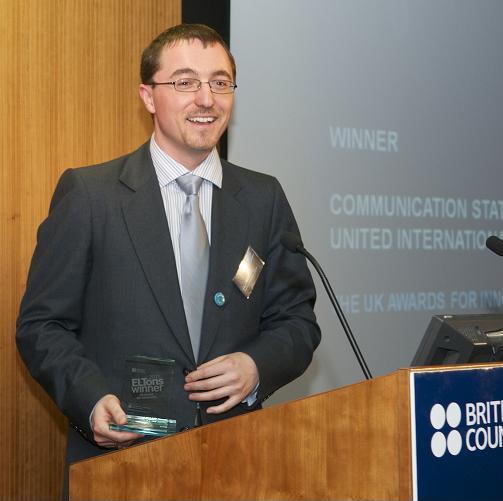
This way of learning English won first prize at the British Council ELTON awards in February for innovation in English language teaching and in our next category, absolutely first class So let’s find out how the students react and how you can sell this as a language learning course.

absolutely oriental
Natalia Pérez Herrasti who is Spanish has been teaching the language in Germany for almost twenty years. Natalia got in touch with us to tell us about the new four volume book she is writing in Spanish about a practical approach to intercultural communication, but our conversation ranged far and wide and the bit I want to play now is when Natalia suggested that one reason that the Spanish and Germans are so different is that the Spanish have a very oriental outlook. I really recommend a visit to Liu Yang’s exhibition of intercultural graphics  as they are very thought-provoking.

absolutely playful
So images are one way of thinking about intercultural situations and games are another. Diversophy is the name of a collection of games which can be played face to face, online in Second Life or on your mobile phone. The Second Life games are free and there is lots of information and free samples on the Diversophy website. I’m hoping to be able to talk to someone from the Diversophy organisation in a future show so that I can get behind the thinking behind playing to learn.

And talking of playing to learn, have you thought about that little conundrum that we presented you with at the beginning of the show? And to make that into even more of a game I have chosen Natalia’s intercultural challenge as the snippet to use in the online dictation game for this show.  By the way, did you notice the date today? One of the items I mentioned on the show is not true! I wonder if you can guess which one? If not, then April Fool!

Our next show will be coming to you from Dr. Laurent Borgmann in Germany on15th April

So long … stay tuned!

The host of this show is Anne Fox : Editor: Markus Scherer

Download
Podcast-Feed
iTunes-Abo

absolutely intercultural 130 +++ China’s one child policy +++ Speaking ‘merican +++ Vicki Hollett +++ indirectness +++

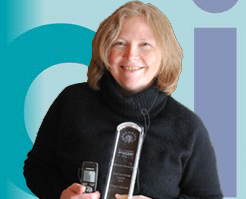
The picture is of me holding our European Podcast Award, beautiful but heavy, together with the Olympus DM 55o Digital Voice Recorder which I used to record this show. OK I promise that this is the last time I’ll mention it! Thanks for the votes and thanks to the whole Absolutely Intercultural team which keeps the whole thing going.

absolutely lost
Tingting Yang is a Chinese teacher of English and corporate communication advisor. There was lots to talk about but having done a Masters in Intercultural Communication and working as an intercultural trainer with Verge Cross-cultural Communication. There was one aspect of Chinese policy which Tingting was convinced has had a huge effect on Chinese culture and that is the one-child policy.

absolutely ‘merican
Now I want to introduce you to Vicki Hollett, author of several successful English language learning books. Vicki is British but moved to the US about ten years ago. Her book Business Objectives, had been very successful in its original British English version so her publisher suggested that they make an American English version. We hear about positive and negative politeness and indirectness as used in Britain and America. To test our understanding of indirect English, Vicki produced a dialogue in which two people discuss what to do about a project which is behind schedule. Is the outcome clear?

And if you need a bit of structured listening or writing practice then you can find several different types of dictation exercises based on a snippet of that interview at the Listen and Write website.

Our next show will be coming to you from Dr. Laurent Borgmann in Germany on18th March

So long … stay tuned!

The host of this show is Anne Fox : Editor: Markus Scherer

Download
Podcast-Feed
iTunes-Abo

absolutely intercultural 128 +++ Nigeria +++ Rosinski +++ coaching +++ Roskilde +++

In this show we’re going to be taking you to Nigeria, the Netherlands, France and the US. One of the great things about the Internet is the niche marketing it allows. One example of this is the radio show Culture Shock: Nigerians in America on Splash FM in Nigeria and which is also podcast. It’s billed as a new talk radio show connecting Nigerians in Nigeria to Nigerians in America and hosted by Abimbola Ishola and Kunle Ayodeji. We’ll also be hearing from Philipe Rosinski, intercultural coach for international business presenting his thoughts about why the coaching approach works in intercultural situations and later talking about some of the cases he has dealt with. 

I’d also like to say hi to Nina Liakos in Maryland who interviewed me about a week ago about this podcast as part of her efforts to learn about how to podcast with the help of the Evonline sessions sponsored by TESOL every year in January. Nina, you did a fantastic job! It was a pleasure talking to you and very relaxing to be the interviewee for a change.

absolutely Nigerian
So let’s start the show by hearing from show number 21 of CultureShock Nigerians when they asked about the types of experiences and impressions newly arrived Nigerians to America had. You can hear more by going to cultureshocknigerians.com where you’ll find all the shows to date since it started last autumn. Thanks to Kole Odutola who alerted me to the show and to the producers for allowing us to bring you snippets. We’ll also hear from a Nigerian comedian Seyi Brown and his experience of coming to the US in 2008.

absolutely doctoral
Now if your interest in intercultural matters is academic you may be interested in a doctoral summer school open to any PhD student in the field which is going to take place in Denmark in early July at Roskilde University. It’s called Identity and Interculturality and will feature some of the greats in the field such as Michael Byram and Claire Kramsch. The 5 day summer school will concentrate on research methods and costs only 50 euros. The deadline to apply is February 28th. Thanks to Fred Dervin for alerting me to that and he is also one of the convenors of the summer school which will take the form of lectures, workshops and roundtables.

absolutely universal
Another way of learning which is becoming very popular these days is through coaching. Our next slot features Philipe Rosinski who gave an hour long webinar on his experiences as an intercultural coach. The webinar was organised by SIETAR which is the Society for Intercultural Education, Training and Research and you can enjoy the whole webinar on their website for free. In the first extract, we’ll hear how Rosinski needed to adapt the coaching approach so that it was a little less American.

absolutely mixed
Rosinski has written books about intercultural coaching, the latest one is called Global Coaching, while the earlier Coaching across Cultures describes the tool he has developed to help individual and teams find out their strengths and weaknesses in the intercultural area. You can try out the individual tool for free by clicking here. What it does is highlight your preferences in terms of a whole range of orientations such as hierarchy, multi-tasking, formality and communication styles and compares them to your abilities in those areas. In a team situation it would help for example to discover if half your team preferred to multi-task while the other half are expecting tasks to come one at a time. The orientations are those which tend to differ in different cultures and build on the ideas of the pioneers in intercultural communication such as Hofstede and Edward T Hall. I tried the test and discovered that I might have difficulty working in a very hiearchical setting for example. Let’s hear now how Rosinski could apply the results of the test to a team of Dutch and French employees involved in a merger.

Our next show will be coming to you from Dr. Laurent Borgmann in Germany on 18th February

So long … stay tuned!

The host of this show is Anne Fox : Editor: Dino Nogarole

absolutely intercultural 126 +++ small talk +++ Frendo +++ Korea +++ respect +++ apps +++

Happy New Year or should that be Appy New Year from Absolutely Intercultural, the podcast about all things intercultural? My name’s Anne Fox and this podcast is coming to you from Denmark. This is show number 126, the first one of 2011 or 20 11 as I should probably start to call it. So why Appy New Year? Well in this show I will be introducing you to 3 so-called apps which could help you in your efforts to understand more about intercultural communication.

This is the first time I’m making a show after learning about our win in the European podcast awards for 2010. We won in the non-profit category and I just want to add my thanks to all those of you who voted for us and also to all those of you who have contributed to the show by speaking with me and Laurent over the years. Without you as our conversation partners this podcast would be impossible.

absolutely trivial
The topic of small talk is often part of a language course, though not a very important one. But when I talked to Evan Frendo in Germany I discovered that small talk is actually a very important building block of working relationships. Here are links to Evan’s blog and his latest book, Intercultural Business English for German learners of English working in Asia.

absolutely useful?
You may remember that in my last show we found out about South Korea from a Chinese perspective when I spoke with Carol who is doing a year’s study exchange there. What also interested me was how she was going to use Korean when she went back to China. So is Korean absolutely useful to Chinese people? Thanks again to Carol who got in touch with us to tell us about her Korean experiences. She certainly showed herself to be adaptable when faced with a sensitive intercultural situation.

absolutely adaptable
And adaptability is something which Kenyan teacher, Samuel Osamba still needs to practice even though he has been in the USA for over 20 years now. Let’s hear how absolutely adaptable he needs to be in the classroom.

absolutely word for word
I think that culture and language are closely connected which is why we often also talk about language learning on this podcast. As a teacher I am very impressed with the web site called Listen and Write in which language learners can do dictation exercises around short audio snippets often from YouTube videos or Voice of America broadcasts. Since we sometimes get asked for transcripts of the show I wondered if we could combine the two and upload short extracts from the show to Listen & Write for you to work with if you are a language learner. So the first one features the first part of Evan Frendo’s segment about small talk.

absolutely essential
But am I right in thinking that culture and language are inextricably mixed? I have recently read a blog post by a respected English teacher who said that he didn’t see any reason to include intercultural communication in his English classes. Since Evan Frendo includes a great deal of intercultural communication in his classes I asked him for his view. Is it absolutely essential in language teaching?

appsolutely mobile
After speaking with Evan I signed up to his Twitter feed and discovered a link he had posted about a language app. Apps are small programs that you can download to your mobile phone, tablet or mp3 player. There are thousands of them and I suddenly became curious whether there were any to do with intercultural communication. So in this final segment we’ll go appsolutely mobile (and I hope you heard my pronunciation there!)

So the first app is called Word Lens and works by translating any sign that you photograph. At the moment the only language pair available is English and Spanish so this means that you can photograph a Spanish sign and get an English translation or vice versa. Useful for restaurant menus I would imagine. The catch here though is that although the app is free, you have to buy the dictionary. But when it works, it’s like magic.

The second app I found was called Fasten Seatbelts and this gives you snippets of information about different cultures both in text format and in the form of short videos. Now this one is completely free. The first edition was a collection of Do’s and Don’ts for European countries and the second edition now covers a range of Asian countries.

The third app I found is called Cultural GPS and allows you to see the different Hofstede profiles for 98 different countries in the free version. In the pro version you can create your own personal cultural profile and compare it to any one of the 98 countries or compare pairs of countries to highlight differences and similarities. This is the one I liked the most and I’d be really interested to find out what you think about it.

All in all I think that this was an interesting little project but I have come to the conclusion that these apps can only help with simplistic culture specifics and don’t really help with the more rewarding culture-general aspects of intercultural communication. But maybe you know of other interesting apps? If so then do tell us about it in a comment here on the blog  or send us an email. We’d also be very happy if you recorded something for us to include in the show. Well that’s it for this show.

Our next show will be coming to you from Dr. Laurent Borgmann in Germany on 21st January.

So long … stay tuned!

The host of this show is Anne Fox : Editor: Dino Nogarole

absolutely intercultural 125 +++ Christmas time +++ New Year’s resolutions +++ international Xmas +++

Today is the 24th of December – this means Christmas trees, mulled wine, lots of snow recently, and if you were lucky you may have spotted the odd reindeer. In our show today I asked how my guests celebrate Christmas in Australia, Hungary and Germany but also how people formulate their New Year’s resolutions in different cultures.

absolutely santa
Our exchange student and podcast enthusiast Lucy Warren talks to Barbara Neukirchen, who is responsible for the outgoing students from RheinAhrCampus, Remagen. Lucy is interested in how Barbara celebrates Christmas time and whether this could be seen as typical for Germany. In our first category Barbara tells Lucy on which days Germans celebrate Christmas and how they celebrate the count-down to Christmas.

absolutely positive
Have you thought about your New Year’s resolutions? For example stop smoking or drinking less alcohol? Or losing a couple of pounds by going to the gym regularly? I asked Beatrice about her resolutions and she explained to me the difference between positive and negative ones. In our second category we listen to Beatrice’s view about New Year’s resolutions.

absolutely festive
I put together a round table with Lucy from Australia, Emese from Hungary and Andreas from Germany. All of them shared their typical customs and Christmas traditions from their families with me. Of course this does not mean that everybody in their culture celebrates in the same way – sometimes this may be just the culture of that particular family or region. Let us listen to very different experience which range from Christmas on the beach to Advent Calendars.

Our next show will be coming to you from Anne Fox in Denmark on 07. January 2011

The Team of “absolutely-intercultural” wishes you a Merry Christmas and a Happy New Year! Thank you for supporting us!

Until then –
Bleiben Sie absolut interkulturell!

The host of this show is: Dr. Laurent Borgmann
Editor: Dino Nogarole

absolutely intercultural 124 +++ Soundcities +++ Korea +++ Kenya +++ TED talks +++

absolutely urban
Recently I came across an intriguing project called Soundcities. The project started in the 90s when an anonymous British artist known as Stanza started making sound recordings in cities all over the world. You can now go to the Soundcities website and choose a city or a mood and hear the sounds associated with it. Of course I went straight to the collection for Aarhus which is my nearest big city and among other things, found the familiar sound that the pedestrian crossing plays when it’s safe to cross the road. The project isn’t over yet so if you fancy going out and making some recordings then Stanza would love you to upload them to the website to add to the database. So what sounds would you record for your city? Well before you decide I’d like you to sit back and relax for three minutes while I play you a medley of sounds from a well-known city. The question is, can you guess which one?  So where did those sounds come from? I’ll be kind and accept answers from the right country. I recommend you go to soundcities.com and play around with the map and the sounds that you can find there. I also recommend the Soundmaps mixer page where you can create your own cacophony using the mixer on the page.  So where did the soundscape come from earlier in the show? I wonder if you guessed Asia? I wonder if you guessed South korea? The sounds in fact came from Seoul. I thought that would be the most appropriate to play for our conversation with Carol.

absolutely delicious
I was delighted when Carol from China contacted us saying she’s be willing to talk to us about her experience as an exchange student in Korea. Carol studies Korean and English at Nanjing Normal University in Jiangsu Province in China. She arrived in Korea in August and we talked about various things including food so this is the absolutely delicious segment but first I couldn’t resist asking how she had heard about our podcast.

absolutely on time
Samuel Osamba has been living in the US for 20 years but is originally from Kenya to which he returns on project work several times a year. He tried to leave a comment on the blog after our piece on the intercultural business webinar in October but there was a technical glitch. That is now solved so thank you Samuel for letting us know about that but also I was curious to find out more so I arranged to ring Samuel to see if he had another perspective on the issue of timekeeping in our segment absolutely on time. Samuel you’re quite right that Africa does not feature often enough in our podcast so if there is anybody out there from Africa who has some interesting stories to tell then please do get in touch.

absolutely critical
I’m not sure that we’ve had recorded critical incidents on this show before but I managed it as I spoke to Carol from China about her year abroad in Korea. Listen as I get it completely wrong not just once but twice in the space of five minutes in absolutely critical!

absolutely back to front
For our last segment I decided to play you one of the shorter sessions from TED talk. If you don’t know TED Talks yet then I strongly recommend that you go over to TED.com and choose one or two from the amazing selection of recorded talks by some amazing people. The TED talks are even starting to have their own superstars such as Sir Kenneth Robinson and Professor Sugata Mitra who both talk about education or Hans Roslin who makes statistics come alive or Jill Bolte Taylor giving a minute by minute account of a massive stroke she had. The TED slogan is ‘Ideas worth Spreading’ and I think they are addictive so watch out. The one I’m going to share with you today is by Derek Sivers’ entitled ‘Weird or just different?’ which is about how what you think may be true may not be true or absolutely back to front! One of our very first podcasts featured South African, Mark Anderson who went to South Korea and specifically mentioned this problem that the streets have no names. So now four years later, problem solved!

Our next show will be coming to you from Dr. Laurent Borgmann in Germany on 24th December

So long … stay tuned!

The host of this show is Anne Fox : Editor: Dino Nogarole

absolutely intercultural 122 +++ besig +++ contracts +++ mindfulness +++ longterm relationships +++ pragmatics +++

In this show we’re going to be hearing about why knowledge of the local culture is important, how different cultures understand the notion of a contract, what sort of intercultural problems business people have, the right and wrong way to express disagreement and lots more. In the past we have brought you tasters from various conferences on intercultural topics and in this show we are very lucky to have been given permission to bring you extracts from the recent online webinar organised by IATEFL’s Business English special interest group on the topic of intercultural communication. IATEFL is the International Association of teaching English as a foreign language and IATEFL has many special interest groups of which Business English is just one. Carl Dowse in Germany was the organiser of this recent webinar and you can see the full recordings on the BESIG webiste at besig.org and they are also on YouTube

absolutely overlooked
We’ll start with an important observation from Baoquan Liu who was talking about how to test intercultural competence in his students when he mentioned something which is often absolutely overlooked…So could YOU describe your own local culture? Baoquan also included an interesting case study at the end of his talk which would be a great starting point for a discussion. You can see the case study on the besig.org website where the recording and slides are available free of charge.

absolutely contractual
For our next segment we are going to go absolutely contractual and find out some of the problems various business people operating across cultures experience with one of the basics of business – the contract. Listen as Evan Frendo, an intercultural trainer, talks about some of the problems he hears about with contracts and why the last thing you want to do is have a lawyer in the room when hammering out the details. 

absolutely problematic
The next speaker in the webinar was Sabrina Gerland, an American based in Germany for the last 30 years, who spoke about the crucial importance of tone and expression. In this segment Sabrina starts by listing the types of real life questions which German business people present her with during her training sessions and then talks about how what you say can also be absolutely problematic even when it is grammatically correct.You can hear more examples of communication going wrong by listening to the whole of Sabrina’s talk on the besig.org page

absolutely mindful
So far we have heard about very specific aspects of intercultural communication in business; be aware of the local culture, what do you understand by the word contract and how can you express disagreement politely. Our next segment, , will bring this all together. Peter Franklin, the final speaker in the Besig webinar, presented results of extensive research into what he calls intercultural interactive competence. He then pulled it all together into an idea called mindfulness… 

absolutely short term
One of the great joys of this webinar was the constant reference to real life, real people and real situations so in our next segment, absolutely short term, we’ll hear why the usuall advice to nurture long term relationships in order to build trust in business may not work. 

absolutely German
And talking of real world problems, I’m going to end the extracts from this webinar with a lovely case study; an incident related by one of Sabrina Gerland’s course participants. I think we have to call this segment absolutely German!

So my thanks to Carl Dowse, the organiser of this wonderful and free webinar, for allowing me to bring you some extracts today.Did you like this taste of an online conference? Do you know of any other relevant upcoming online meetings? Do you have an idea for a show or a segment of a show. Do get in touch if you’ve got something to say about the podcast. And don’t forget that if you catch the show online it is now very easy to do so on your iphone or ipod.

The next show will be coming to you on 1 October from Dr. Laurent Borgmann in Germany.
So long…stay tuned!
The host of this show is: Anne Fox
Editor: Dino Nogarole

absolutely intercultural 120 +++ Serious Games +++ Haji Kamal +++ Wiglington & Wenks +++ SIETAR +++

Welcome to AbsolutelyIntercultural, the podcast where we look at all things intercultural. We’re going to see if playing games can increase your intercultural knowledge. I’m talking about serious games which are becoming more widespread in education at all levels.   

absolutely serious
Mikkel Lucas Overby works for a Danish company Serious Games Interactive which has produced several games both in Danish and English which are mainly aimed at high school students. The games explore topics which we all know something about such as the Israeli Palestinaian conflict, child soldiers in Arifca or child labour in Asia. But the difference here is that you are on the ground and have to deal with the situation by interacting with the different people involved. I tried out a couple of these and so did my daughter, Gwen. But are there limits even within Serious Games? It seems yes when you hear what Mikkel has to say about their forthcoming game about the slave trade.  I started by asking him how the Serious Games Interactive company started and how they chose the topics of their games.

absolutely playful
As you heard I got to play a couple of their games and so did my daughter Gwen who took on the role of a buyer from a European clothes company inspecting reports that the factory which sources their leather uses child labour. How did she fare?

absolutely military
And what about war? We’ve mentioned this before on Absolutely Intercultural but one of the groups which need intercultural communication skills the most are soldiers. Think for example about the situation in Afghanistan where you need to get on with the locals for all sorts of reasons including to get a continual stream of information from them. In the game ‘Connecting with Haji Kamal’, Lieutenant Justin Harril is about to meet Haji Masoud Kamal, an influential local leader who Harril hopes will become a longterm contact. Harril knows that Haji Kamal is going to offer him chai, the local tea which he really doesn’t like? We hear the advice offered by two other officers. The Lieutenant has the following choices, refuse saying he’s not thirsty, refuse saying he’s allergic or accept. What’s the best choice? The game is available online from the World Warfighter company which specialises in military intercultural training through games.Earlier we had a taste of the type of interaction faced by soldiers in Afghanistan. The game Connect with Haji Kamal is available online at worldwarfighter.com and takes about 10 minutes to play. You heard the first dilemma at the beginning of the show when Lieutenant Harril is offered tea which he thinks he won’t like. What did you decide he should do? Of course if you refuse his hospitality then that won’t start your relationship with him on a good footing. How might the visit continue? The soldiers noticed a field of cannabis plants growing close by Haji Kamal’s house – should they mention it? So the choices are to compliment Haji Kamal on his cannabis crop, admire the hills or suggest that you get down to business. What would you choose? I think this game would be a great discussion starter plus it is a great way to try out various strategies without the consequences being too bad as you can always re-start the game. So what if you had refused the tea? If you want to see how the situation develops you’ll have to go to the worldwarfighter website and play the game yourself. And if you have any comments about how you did or what you think of the game then you can leave them at the end of this blog post.

absolutely virtual
There are intercultural games for children in the virtual world of Wiglington and Wenks where you can visit Brazil, London and Madagascar finding out about the places as you go. I sent my younger daughter, Mia on safari to explore Wiglington and Wenks. I had a feeling she was older than the target group but younger children might learn something about the world in Wiglington and Wenks.

And there are also intercultural quizzes in one of the most famous virtual worlds of them all, Second Life. SIETAR is the society for intercultural education, training and research and they have equipped a whole floor of their building in Second Life with over 30 quizzes about different countries. So for example in the quiz on Sweden you can answer a question about being offered a pat of butter on a butter knife at a dinner. What happens to the knife? Do you only use it to put the butter on your plate, or use it to butter your bread and then return it or use it and keep it as yours? The answer is butter your bread and return it. If you want to try the rest of the quiz or quizzes for other countries then you can find the link to SIETAR’s place in Second Life here.

So what do you think? Could playing computer games help raise your intercultural awareness? Did we miss out some really good digital intercultural games? I’d be very curious to hear about your experiences with any of the games I’ve mentioned and any that I missed out.

The next show will be coming to you on 29th October from Dr. Laurent Borgmann in Germany.

Until then have fun!

The host of this show is: Anne Fox
Editor: Dino Nogarole

absolutely intercultural 118 +++ Kenya +++ Zachariah +++ Gallaudet University +++ Mike Marzio +++ Real English

In this show we’re going to be covering three very different topics with one person, Mike Marzio. In actual fact I’ve been wanting to invite Mike onto the show for a long time mainly to tell us about his wonderful Real English set of video lessons but right now Mike has a pressing reason to talk to us. You may remember that way back in 2006 we featured deaf students from Gallaudet University and how they could express themselves online with hearing Israeli students. Now Mike would like to raise $30,000 to send Zachariah from Kenya to do English at Gallaudet University. We also hear from Mike about his days in the sixties as a civil rights worker helping black people register for the vote and the culture shock he experienced just by visiting a different part of his own country. 

absolutely worthwhile
So let’s find out how and why Mike is trying to raise $30,000 dollars to send a young man from Kenya to college in the United States.  And just to repeat the web address where you can find out more about this project, that was http://zachs-fundraiser.blogspot.com  Finally we also hear more about what Zachariah hopes to do once he has completed his studies in America.

absolutely eligible
Back in the sixties Mike worked as a civil rights worker helping black people to register to vote in the southern states of the US and what he experienced was culture shock in his own country!

absolutely real
If you’ve heard the name Mike Marzio before it’s probably because of the Real English series of videos which Mike has made since the early nineties to help people learn English by hearing Real English. We hear more about why he had the idea and how it works.

absolutely daily
As an added bonus on the blog, we include here an English lesson which is based on the story of Zach in Kenya. The lesson was prepared by Sarah Lilburn of the Daily English Show fame. Her blog includes the text of the “conversations with Sarah” section of this show, and a lot of other interesting information about Zach’s area called Karagita, in or near Naivasha, Kenya.

If you want to help, see below.

The next show will be coming to you on 1 October from Dr. Laurent Borgmann in Germany.

So long…stay tuned!

The host of this show is: Anne Fox
Editor: Dino Nogarole

absolutely intercultural 116 +++ Languages Out There +++ Jason West +++ Verge +++ China +++ Morocco +++ Chantiers Sociaux Marocains +++

Chantiers Sociaux Marocainsabsolutely out there
Back in March we talked about the Languages Out There approach by Jason West which consists of preparing students in the classroom and then sending them out with mini tasks which involve interacting with the general public outside the classroom. For those classes not based in English speaking countries Jason suggests organising students to interact with English speakers online. I spoke to Jason about how he developed that side of the approach and how practical it could be.

absolutely online
After speaking to Jason I decided to ask Richard Wood of Verge  in China how he applies the Languages Out There approach in an environment with very few native speakers available to practice with.  While speaking to Richard Wood I realised that the Language Out There approach is simply what a motivated person might do and what Jason West’s methods do is to enable less motivated or less confident learners to make progress.

absolutely voluntary
I met Rachad Izzat from Rabat in Morocco at the Anna Lindh Foundation Forum in Barcelona in March. Rachad is Programme Manager at Chantiers Sociaux Marocains which organises volunteer work all over Morocco and he explained how voluntary work lead to intercultural exchange without needing to leave Morocco.If you wanted to get involved with CSM you could for example sign up to a trekking project this September or October staying with local hosts, learning a little Arabic and being shown around some of the main historical sites and then trekking in the Atlas mountains. You will find more information on their Facebook page.

The next show will be coming to you on 3rd September from Dr. Laurent Borgmann in Germany.

So long…stay tuned!

The host of this show is: Anne Fox
Editor: Dino Nogarole