In this episode we are going to have a look at adult education. Anne and I were lucky enough to be invited to the Volkshochschule Rhein-Sieg by Alexandra Haas. We took part in a very stimulating workshop day for trainers inspired by Alexandra’s previous project “Teaching Culture!”.
absolutely learner-oriented: Mechthild Tillmann, director of the Volkshochschule Rhein-Sieg, reports on 24 different work-shops in which teachers shared ideas about marketing, suggestopedia, podcasting in the classroom and other subjects related to their teaching. Following the idea of “teaching culture” and the “culture of teaching” the institution invited their own teachers to turn into learners and improve their methods.
absolutely bossanovarized:
We listen to Mauricio Virgens from Brazil and Andres Villamil from Columbia, two South American musicians who played music for us, and “bossanovarized” our busy lives a little. Mauricio speaks about his mission as a cultural ambassador for his native country Brazil and tells us how he keeps up his cultural identity through music. Of course, we also get to enjoy a bit of their music.
absolutely enjoyable: Katrin, one of the new staff at the Volkshochschule Rhein-Sieg, tells us how previous learning experiences of the participants can a be challenge for the teachers. She has noticed that learners seem to expect the same “learning culture” which they got used to when they were learners for the first time – years ago. However, one aspect seems to be important to all learners – that they learn faster if they are having fun.
absolutely gendered:
Evi and Linda both work in adult education and explain to us how adult education creates its own culture. We also hear about their perspectives on gender issues and that adult education, just like health services, appears to attract women with a strong impulse to help.
The next show will be coming to you on 17 October from Anne Fox in Denmark.
Today’s show is about people who live in the past, more specifically about those who live as Vikings for one week in the year or every summer weekend depending on their role. What makes them prefer the Viking era over any other? How authentically do they try to live the Viking lifestyle? Is there anything we can learn from this living tableau?
We’re going to the Mosegaard Viking Moot, a gathering of people from all over the world who just want to be Vikings. Every year at the end of July, just south of Aarhus, the Vikings meet to show off their horsemanship, their handicrafts and their fighting skills for a week. People live as Vikings, more or less, and at the weekend the public are invited to join in. Since I have been enjoying this for many years I decided that this year I would be brave and approach some of these warriors, feisty women and well-travelled minstrels to try and find out what makes ordinary people try to step into such a faraway culture so completely.
absolutely historical: I spoke to Peter Hambro Mikkelsen at the Mosegaard Museum to get some background to the event and only then did I find out how special the Mosegaard Moot really is!
absolutely homely: Now let’s hear from some of the enthusiasts who live as Vikings. First I talked to Grethe, a conscientious Viking woman who makes all her own clothes and who comes to Mosegaard with her husband who is a horseman.
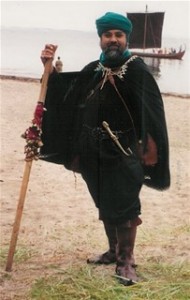
absolutely exotic: As I was wandering round the encampment, buying pancakes and roasted meat and getting smoke in my eyes, my gaze was inexorably drawn to a very exotic looking person even by Viking standards: This turned out to be the alter ego Ibn Fadhlan who revealed his Arabic roots and recommended the 2005 film ‘Kingdom of Heaven’ as a fair representation of the Crusades story.
absolutely violent: Then I could put it off no longer; I simply had to gather all my courage and nail down one of the warriors to find out what made them come from all over Europe and beyond to fight. I’d always been intrigued by the number of English voices I’d heard on the battlefield over the years so I made sure that it was a Briton that I talked with. The voice belongs to Ian Judd or Gunnar as he is known in Viking circles.
absolutely historical:
Finally we return to Peter Mikkelsen from the Museum to find out if there is anything we can learn through these cultural recreations. This leads to an interesting parallel between how there was class distinction even in death in the Viking era but that the same distinction was made during the Falklands War when privates were buried in a mass grave on the Islands while the fallen officers were flown home. Peter ends with a powerful anecdote about the strength of the Viking identity.
In today’s show, we put our emphasis on working cultures, both, in digital work contexts and in face-to-face team work.
Whether you prefer to work in a hierarchical context or whether you prefer to work collaboratively – we sometimes end up in workplaces which do not leave the choice to us. Are you aware of the working culture that surrounds you? Do you appreciate it or would you change it if you could? Do you notice that you have an impact on this culture, too?
absolutely structured:
We hear about different email cultures and discover that yes – your email may show your personal writing style – but that your email also says a lot about the working culture of your company or your institution. Our interviewees fill us in on their opinions regarding the perfect email. We learn that signals which indicate whether the message is well structured and can easily be read and dealt with are quite important and that preference is often given to those messages which have a “speaking” subject line.
absolutely international:
Different working cultures in face-to-face teamwork are explored. Jean Lennox of the University of Applied Sciences in Mönchengladbach, Germany, reports about an international excursion with university students to Posnan, Poland, which confronts them with the difficulties of working in groups of European students from various countries. We learn that intercultural tests of what we expect of the working cultures of other countries can bring up interesting results.
absolutely mobile:
Nora Müller, who is going to the Netherlands for her practical training, gives us some insights into her preparations for her stay abroad and tells us that she believes that going to a neighboring country in Europe is still a big step.
Dr. Cruickshank from Scotland and Clementina Poposka from Macedonia came to Germany as lecturers under the “teaching staff mobility” program. We get to hear what they hope to gain from their academic mobility and in which way universities in their home countries differ from what they experienced during their visit.
The next show will be coming to you on 19 September from Anne Fox in Denmark.
With the Olympics in full swing it seems obvious to turn our attention to China this time round. However if you think that we’re going to be talking about heights, lengths, points, timings and goals then you’ve come to the wrong place. But maybe by now you have an idea what the intro music was. It didn’t sound stereotypically Chinese but Forever Friends is the official anthem for the Beijing Olympics.
So what are the intercultural aspects of the Olympic Games? The list is long and could begin with the opening ceremony which was a lesson in world geography with the majority of the world’s countries represented, even those currently in conflict such as Afghanistan and Georgia as well as many small nations such as Andorra and Cape Verde. Be honest, how many flags did you recognize? I was also struck by the number of parading athletes using their mobile phones mostly to take pictures but also in conversation. The formality of the occasion has obviously been very much reduced. I can feel a theme for a future show coming on!
As the games swung into action inevitably another issue raised its head, that of cheating. What is cheating? I’m not referring here to using drugs to enhance performance but of the strange story of the Danish sailors. The weather conditions for the start of the race were very rough and the mast of the Danish boat broke. Instead of bowing out of the race, the Danes asked the Croatians, who were no longer competing, if they could borrow their boat. The Croatians said yes, the Danes set off late and incredibly went on to win the competition on aggregate and were in line for the gold medal. But it took 18 hours for the judges to decide whether the Danes had broken any rules by borrowing the Croatian boat. In the end the Danes were awarded the medal but other nations have put in official complaints. So was that cheating? Let us know what you think.
absolutely yours:
Firstly hello to Zohre Ovezliyeva in Turkmenistan who administers the American Peace Corps programme there. I was so interested in Zohre’s work that I arranged to link up with her for a future show so watch out for that.
Then we heard from Christopher Cummings who wanted to tell us about his Spanish language learning site at Spanishdict.com and who also told us that some of our pieces resonated with him as an Asian American. I hope that we can get Christopher to tell us more about his approach to language learning in a future show.
Hello also to Eddy Van Hemelrijck in Belgium who was interested in getting his students involved in producing some material for the podcast. Yes of course, we’re very open to suggestions like that and I am very much looking forward to seeing what they come up with.
absolutely olympic:
Today we’ll be hearing from Ken Carroll, a Dubliner who has lived in Shanghai for 15 years and who offers online language training through Chinese Pod, French Pod and Spanish Pod. What does he think is the significance of China hosting the games? Inevitably we started talking about learning the Chinese language too.
absolutely proud:
We’ll also be hearing from Yaodong Chen, a professor of English at Guangxi University in Liuzhou and one of his students Justina, currently working as an intern, about whether they will be watching the games or not.
absolutely behind:
A recurring theme seems to be homework in China. This reminded me of an interesting initiative happening in the USA at the moment called 2 million minutes. That is the amount of time available to the typical teenager to qualify themselves for university in high school. The project is making a series of films documenting how teenagers in India, China and the USA are spending their time during this critical period and it will be no surprise to learn that the Chinese students spend a great deal of time doing homework compared to the Americans. Although you need to buy the main film there are many short clips available for free on the project website and on You Tube.One of them features Bob Compton, the executive producer, giving his answer to a typical question about how students in China feel when they get low marks.
absolutely olympic (part 2):
What? More inter-cultural aspects of the Olympic Games? Well how about, is it about individuals and teams or about countries? I know many people are simply looking at the medal tally for each country but in the Olympic Charter it does explicitly say, and I quote:
‘The Olympic Games are competitions between athletes in individual or team events and not between countries.’
Finally, isn’t there a tension between the supposed coming together of nations and the inherent rivalry in sporting events? I heard one athlete interviewed who said ‘I didn’t come here to socialize with the other athletes!’ and in fact there doesn’t seem to be anything in the Olympic Charter compelling him to do so!
Well that’s it for today. Thank you to everyone who took part, we couldn’t do this without you!
So long! Stay tuned.
The host of this show is:Anne Fox
Editor: Peter Kron
In today’s show the emphasis is on students who decide to spend some quality time abroad. What are their choices, how do students need to prepare themselves, when should they start with their intercultural preparations? Most students, whether they take a Bachelor or a Master course, have the opportunity to go abroad for some time during their studies. Our interviewees tell us what the benefits of such a study abroad period can be.
absolutely welcome:
At most universities the international offices try to highlight students’ opportunities for going abroad by celebrating an international week at least once a year. The university invites representatives from their partner universities who can then explain and advertise their study programmes and answer specific student questions concerning the best choice of courses, the credit points which students can gain during their stay abroad and also questions concerning accommodation or living costs in their countries. Listen to Prof. Henzler, president of the University of Applied Sciences Koblenz as she welcomes the delegations from the different partner universities on the first day of the international week.
absolutely useful:
From the student perspective the presence of the foreign guests offers a number of opportunities. They can follow lectures in foreign languages, can get to know teachers and administrators from the partner university before they arrive there and make informed choices as to which university would be the best one to go to. We listen to one of the student representatives of the “go-out”-initiative (German Academic Exchange Service – DAAD). Gerrit tells us that he sees the main benefits of these periods abroad in the fact that they create new and unexpected opportunities to expand your own personality and that well-documented experience abroad is a great plus when you are looking for a new job – because it seems to be a strong signal to the prospective employer that you are motivated, flexible, and that you show initiative and speak foreign languages.
absolutely integrated:
Most universities have orientation weeks where all foreign students get together and get basic information or do excursions around the university in order to facilitate their integration. Some universities have “buddy programs” where the incoming foreign students are paired with local students whose task it is to integrate the newcomers as quickly and as thoroughly as possible. Adelheid Korpp, who is in charge of the “incoming students” at RheinAhrCampus tells us what the university offers to make sure that the students from the partner universities have the best start, get integrated quickly and, if possible, feel at home in their new surroundings right from the beginning of their stay.
absolutely strategic:
Students should prepare themselves interculturally for their stay abroad before they arrive at their new destination. Barbara Neukirchen, who looks after the “outgoing students” at RheinAhrCampus and coaches them during their application process for universities and scholarships tells us how students can plan a successful stay abroad if only they start the planning phase early enough.
absolutely prepared:
In our last interview Carsten Ritterath a Bachelor student of business administration reports about his preparation for an internship in England. His football coach helped him find the English organisation where one of his tasks will be to compare English and German approaches to health management in companies. Carsten has applied for a scholarship from ERASMUS-placements and he tells us what he needed to do in order to apply for this. He wrote a letter of motivation, a curriculum vitae, he took part in an intercultural seminar and he had to pass an English test. We are keeping our fingers crossed for him to get the scholarship in the end because accommodation in London can be quite expensive.
Our next show will be coming to you on 22 August from Anne Fox in Denmark.
Today we are going to Dubai, the centre of the world, to which increasing numbers of tourists and business people are coming. How do you prepare the nationals of a very conservative society with fairly strict gender separation for these intercultural encounters? Canadian, Mark Karstad, instructional designer at Dubai Women’s College for five years, decided to develop virtual fieldtrips to the USA, South Korea and Darfur amongst others through the virtual world of Second Life. The whole show is given over to exploring some of the many issues raised by this decision.
absolutely virtual:
Very few of the students at Dubai Women’s College take advantage of offers of foreign trips such as attending a trade conference in China. Mark Karstad, former instructional designer at the university, tried out the idea of virtual field trips using the online world Second Life. This enabled him to take his students to a range of safe destinations such as Islam Online and Darfur. It also enabled him to collaborate with a college in South Korea and the USA to enable virtual meetings with the students where for example the students came dressed in their national costumes.
In Second Life an avatar, a sort of cartoon character, represents you as you move and interact in the online world. You choose what this avatar looks like and how it is dressed. How would the students of DWC choose to represent themselves? The answer was without their abayas and in the designer clothes which they wear underneath. As Mark describes it, bling, meaning ostentatious jewellery.
absolutely private:
As a male employee in the women’s college Mark describes some of the norms he had to adhere to such as never coming into physical contact with the students, not even bumping into them on the stairs. He also describes how the students needed to have a chance to put on their abayas and shaylas before he entered the classroom. This meant that he had to knock and pause for word that it was safe for him to enter the room.
So long! Stay tuned.
The host of this show is:Anne Fox
Editor: Peter Kron
“Germans are all punctual but don’t have a sense of humor, people from Great Britain do and always have their tea at 5 pm in the afternoon, Italian men pick up girls all the time, the French eat baguette, cheese and frogs’ legs. Women can’t drive cars and men simply cannot listen, young people are irresponsible because they get drunk all the time and old people are terribly inflexible.” You could easily continue this list about any nationality, age, gender, political or sexual orientation. Stereotypes are pre-fabricated phrases to generalize about certain groups of people. But how are they generated? Do they have any practical use in daily life or are they just wrong and useless? Are their fixed for all time once they have been established or can they change over time? In this show, we try to find some answers to these questions about stereotypes.
absolutely Spanish: Emma Cuevas-Saunders, who is an ERASMUS student from Spain, has been studying and doing a practical training in Germany for about a year now. She tells us about her experiences with stereotypes in Spain and how prejudices about Germans almost prevented her from going abroad. We also learn that Spain, known as a nation marked by national pride, actually is divided into many different sub-groups, which each have stereotypes about the other groups. However, as Emma says, this is a rather positive aspect, because it demonstrates Spanish diversity and these stereotypes are also used as a conversation starter. But first, she tells us, that all Spaniards have discovered a new pastime: They like to sit on the beach and guess the nationality of the tourists, but perhaps this is also a stereotype?
absolutely Mexican-American: In our second category we talk with Susana, who has her roots in Mexico, lives in the United States and currently is studying in Germany for one year. Although she is probably the expert on this topic, we thought she tends to underestimate the popularity of her two “home countries”, thinking that they are not very much liked in the world. We learn that stereotypes really can change over time, if people like Susana have the courage to go abroad, make their own experiences and afterwards, tell people about it.
absolutely Austrian: We speak to Dr. Nicole Slupetzky from “Volkshochschule Salzburg” (institute of adult education) about the challenges connected with harmful stereotypes and the opportunities of friendly ones. While friendly stereotypes can provide you with conversation topics and sometimes make these conversations run more smoothly, harmful stereotypes can be responsible for hate and racism. Nicole emphasizes that it is important to talk about these stereotypes, to learn about the affected groups and sometimes even to laugh about these statements together. We discuss that, of course, we shouldn’t believe every stereotype we hear, because they can be produced in many different ways, by the media, the family or even education.
Welcome to the 60th show of Absolutely Intercultural, the podcast about all things inter-cultural. In many cultures, 60 of anything marks a celebration. For example if you have been married for 60 years then that is your diamond jubilee and everybody has to give you diamonds!
absolutely vocational: Firstly we go to the closing event of a European project, Brydlydmuren, (break the sound barrier) all about using sound in vocational education. Students had done all sorts of sound-related work including a collaborative project with a university in Turkey. This final event took place in a large hall in the city of Aarhus and included displays and experiences such as a blind restaurant, which is where you eat in complete darkness so that your other senses come to the fore. One of the events was a Skype video conference with the Turkish university.
absolutely culinary: I attended a chat show featuring one of Britain’s celebrity chefs, Jessie Dunford Wood. This was another of the events offered by Language Lab, the online language school based in Second Life. One of the attractions of going to these events is that you can participate by asking questions yourself. So what comes to mind when you hear the phrase British food? Would you go to a British restaurant for a special treat?
In the second extract from the Jessie Dunford Wood session we hear about the difference between a chef and a cook and why the athletes had to bring their own food to the London Olympics in 1948. In the podcast I promised you could see a memo written at the time by British civil servants who were checking on how the different national teams were coping with their British food rations. One I particularly liked was about the Mexican team. The civil servants noted that ‘the habit of regarding food as a precious commodity was foreign’ to the Mexican. See the memo here.
Politically the different member states of the European Union have already achieved surprising synchronisations which would have seemed unthinkable 20 years ago. Culturally, however, most countries try to keep their own identity within the Union. Imagine you leave Germany and go South to Slovenia, Portugal, or Greece. In every single nation you can experience different cultural habits and, as a consequence, different working and life styles. Apart from reporting about how we had a Royal Visitor from Ghana (see on the left) in our classroom , in this show we mainly hear about some differences between the South of Europe and the North. How do the various cultural differences influence our working styles in joint projects or when students are studying in another one of these European countries?
absolutely philosophical? In show 57 we talked about how teamwork in internationally mixed groups is influenced by different cultural habits. In this show, we put the emphasis on how the work itself can be different and we hear, that often for people from Southern Europe the result is not the most important concern, but that the way how the result should be achieved needs more attention and discussion. Sometimes, in the eyes of the Northerners this can lead to seemingly endless “philosophical” discussions with uncertain outcome. For Germans, this often seems as if “they just like to talk and talk a lot”, because the function (e.g. trust-building) of this kind of communication is not so obvious. However, our interviewees also recognize, that all different ways are “kind of right” and that you just have to learn how to handle different styles so that in the end you can work successfully in all international environments.
absolutely quiet: Petros is an exchange student from Greece, the country of the ancient philosophers. He is now in Germany for his semester abroad and you could get the impression that he somehow enjoyed that there was not so much talking in public places and generally more discipline. Leaving the strike-ridden university system in Greece he stresses that he likes that German students are very quiet in the library and also very reliable when it comes to group work or presentations. It seems that Petros can confirm most of the stereotypes people around the world have about the Germans, that most of them are disciplined, reliable and punctual. He also tells us that he first had problems with “proxemics”, the attitude to personal space, distance and touching each other during a conversation, but that he learned a lot for his future in international work places.
absolutely royal: We speak to Georg Reifferscheid, a student at RheinAhrCampus, who recently made a real king from Africa visit our campus and hold a panel discussion with students about development aid. Herr Meickl is an architect from Germany, who was made king by a Ghanaian village, because he had invested so much of his time and energy in his development projects there. Mr. Meickl showed the students the difference between development and financial aid and also presented a video of his “crowning ceremony” in Ghana. Georg shares his initial worries and experiences with us telling us how this unique opportunity came up and what he learned on the event management side.
absolutely improved: In our last category we talk to Maria Koenen, teaching assistant on a Business English course, about various opportunities to improve your language skills. She tries to motivate her students not only to learn during the course, but to combine your hobbies with learning English at home or even on your way to work or to university. The result is, that all students now try out different things to improve their English outside the classroom
absolutely complimentary Thanks to Tammy Roberts from Nashville for some kind words about the show. Tammy organises international exchanges for high school students. Amongst other things Tammy wrote: ‘Your podcasts have helped me to understand different cultures around the world which has helped me to relate better with some of the students. One small example was the German student that thought I was very odd for flying a US flag at our home. … once I heard your podcast on Germans flying flags, it clicked why she was not comfortable with my display‘. We love stories like that. So if you have another example where you found the podcast useful then let us know by leaving a comment here.
absolutely shocking
Juliette Towhidi is widely known for her screenplay of the film ‘Calendar Girls’. This is a very British movie based on a true story. The Women’s Institute or WI as it’s known, in Britain, is an old-established organisation originally for farmer’s wives to get together and swap recipes and knitting patterns. At least that is the stereotype. The film tells the story of a group of friends at a Women’s Institute in Yorkshire, one of whom has a husband who dies of cancer. The friends decide to raise money for cancer research in a very unusual way by making a calendar posed by members of the WI in various states of tasteful undress. Tasteful means that although they are wearing fewer clothes than they should, you don’t see anything that you shouldn’t. Remember that these are mainly women of ‘a certain age’ as we say politely.In real life thousands of copies of the calendar were sold and the story became widely known.
This was a virtual event which happened in the virtual world, Second Life. The chat show was one of a series of events organised by Language Lab, a pioneering language school which operates 100% in Second Life. They have built a whole city with a theatre, art gallery, café, toy shop and church to name but a few of the locations where you can have your language lessons. As well as more traditional lessons, they also organise events such as art exhibitions and the chat show which features in this podcast. The great thing is that you are not watching a TV here, you are part of it. They have even hired actors who staff the café, shops and other buildings so that you can have the full inter-cultural experience. For example the audience at the Juliette Towhidi interview could slip the chat show host a note with a question for the movie writer.
absolutely secret What is the secret of a good education? Finland is a country which regularly tops the PISA international comparisons and at a recent conference I attended, the audience couldn’t help questioning the Finnish presenter Timo Väliharju of Mediamaisteri about the secret to Finland’s success.
absolutely sacred In this segment Juliette is talking about another film, London Kebabs, which she was involved in which explored religious and cultural differences.
The next show will be coming to you on 13th June Dr. Laurent Borgmann from Germany .
So long…stay tuned!
The host of this show is: Anne Fox
Editor: Peter Kron
We use cookies to ensure that we give you the best experience on our website. If you continue to use this site we will assume that you are happy with it.